 elyob
elyob
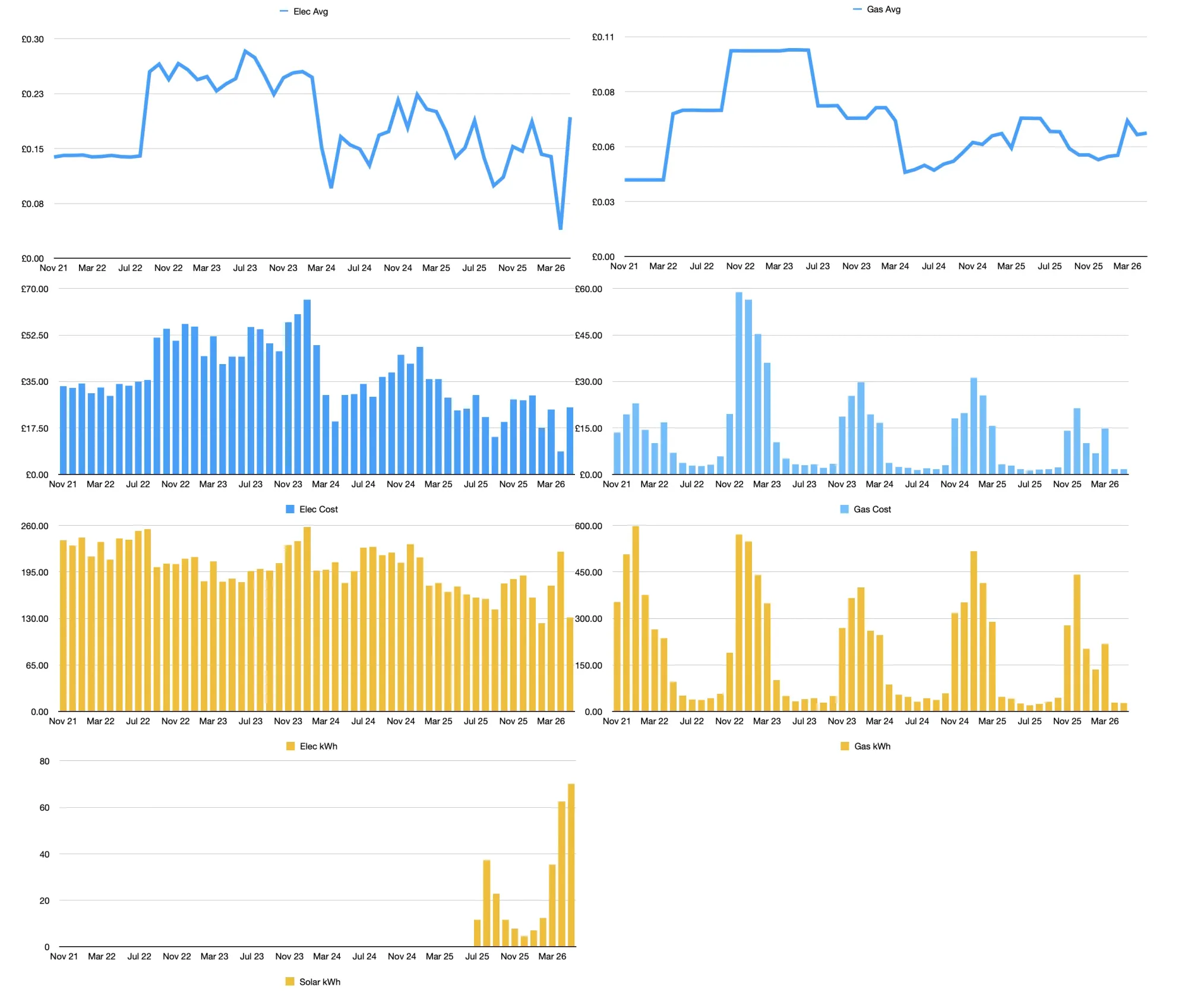
A friend asked me what the energy crisis looked like on a normal household bill. So I pulled five years of monthly readings from Octopus into one chart — electricity and gas, average unit price and total cost, kWh used, and the new line at the bottom: solar generation. It tells the story better than any headline did at the time.
The chart embedded as the feature image is split into five pairs: average unit price (top), monthly bill in £ (middle), monthly kWh used (yellow bars), and solar production along the bottom. Everything's plotted on the same time axis — Nov 2021 through to May 2026 — so the eras line up. The story lives in four phases.
| Era | Elec p/kWh | Gas p/kWh | Monthly elec £ |
|---|---|---|---|
| Pre-war calm Nov '21 → Jul '22 | ~14p | ~4p | ~£30 |
| Crisis Aug '22 → Mar '24 | 28–30p | ~10p | £55–65 |
| Rebound Apr '24 → Jul '25 | 17–22p | 5–7p | £25–40 |
| Solar + Agile Aug '25 → now (data era) | 3–19p effective | 5–7p | £8–25 |
🌱 2021–22: The cheap-energy baseline
From the start of the chart through about July 2022, my electricity average sits at ~14p/kWh and gas at ~4p/kWh. Monthly electricity bills hovered around £30, gas was £15-25 in winter and almost nothing in summer. Boring numbers, boring lives, no kit. Nobody talked about energy prices.
This was the world before the wholesale shock — gas storage levels normal, generation healthy, Europe was buying Russian gas on long contracts at sensible rates. It feels archaic to look at now.
🔥 2022–24: The Ukraine spike
Russia invaded Ukraine in February 2022. The wholesale gas market — and electricity-from-gas, which sets the UK marginal price — detached from sanity by autumn. The chart shows it plainly: my electricity average jumps from 14p to ~28-30p/kWh over a couple of months. Gas roughly triples to ~10p/kWh. Both stay parked at those levels through the whole of 2023.
The monthly bill bars in this period are stark. Electricity hit £55-65/month for most of late 2022 and 2023, against the £30 baseline. The single tallest gas bar — November 2022 — was almost £55, when in pre-war times the same month would have been £20. Two winters of "leave a jumper on, the heating's expensive," all flowing through that smart meter.
The government's Energy Price Guarantee took the edge off the unit rate, but every extra kWh still cost noticeably more than before. The bills don't lie about that.
The cliff has receded but the ground it left behind is permanently higher.
🌅 2024–25: The partial rebound
By spring 2024 the wholesale market loosened. My electricity unit price drifts back to ~17-22p/kWh, gas to ~5-7p. Still about 50% higher than pre-war on electricity, never quite returning to that 14p baseline. Monthly bills stabilise around £25-40 elec, gas visible only in winter spikes of £15-30.
This is the new normal. Anyone hoping for a full snap-back can keep hoping.
☀️ Mid-July 2025: Proper kit arrives
The bottom strip of the chart is empty until the rightmost ten or so months. There was actually a smaller setup before that — an Anker PowerHouse 757 (1.2 kWh portable) bought back in October 2022, with three panels feeding it, scrapping data off the screen via a Blink camera and OCR. Functional but fragile. I don't trust those numbers, so the chart doesn't show them — that's the "bad data period" before the proper kit went in. The full story belongs here now, so here it is.
October 2022: The PowerHouse Experiment
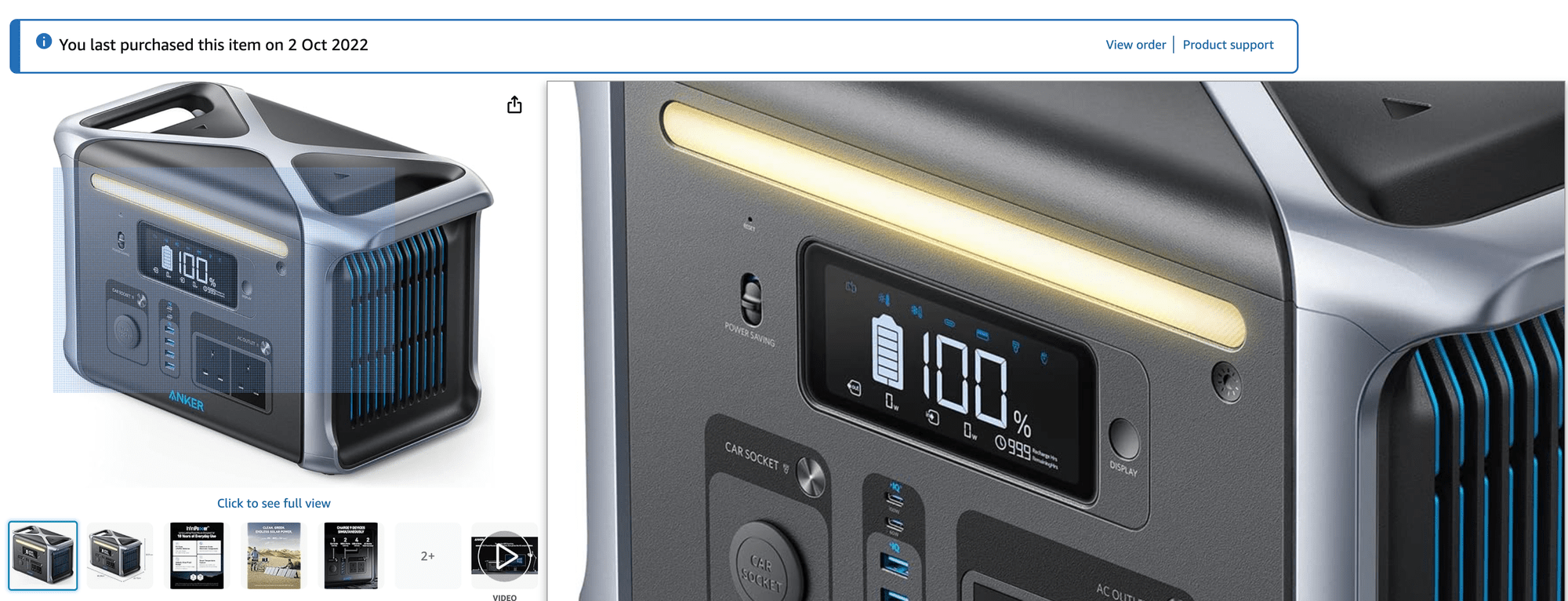
Before the proper solar build, I had been experimenting since October 2022 with an Anker PowerHouse 757 — a 1.2kWh portable power station bought right in the thick of the energy crisis. Getting data out of it was a project in itself: a Blink camera photographed the front panel display, a Zigbee FingerBot pressed the button to wake the screen up, and OCR software read the charge percentage from the resulting image. It mostly worked, right up until something nudged the camera or the unit slightly and the whole pixel-level OCR positioning had to be recalibrated from scratch. Functional but fragile. I sold it in July 2025 when the proper system went in.
Three solar panels were connected to it — the fourth could not be added without exceeding the PowerHouse's maximum solar input rating, so it sat unused. With three panels feeding into a 1.2kWh battery, on a decent day the unit would charge fully from solar alone, meaning that 1.2kWh of daily consumption was effectively free. At crisis electricity rates of £0.29/kWh, a full daily cycle from solar was worth around £0.35 — call it £5–8/month in a reasonable month once weather and shorter winter days are factored in.
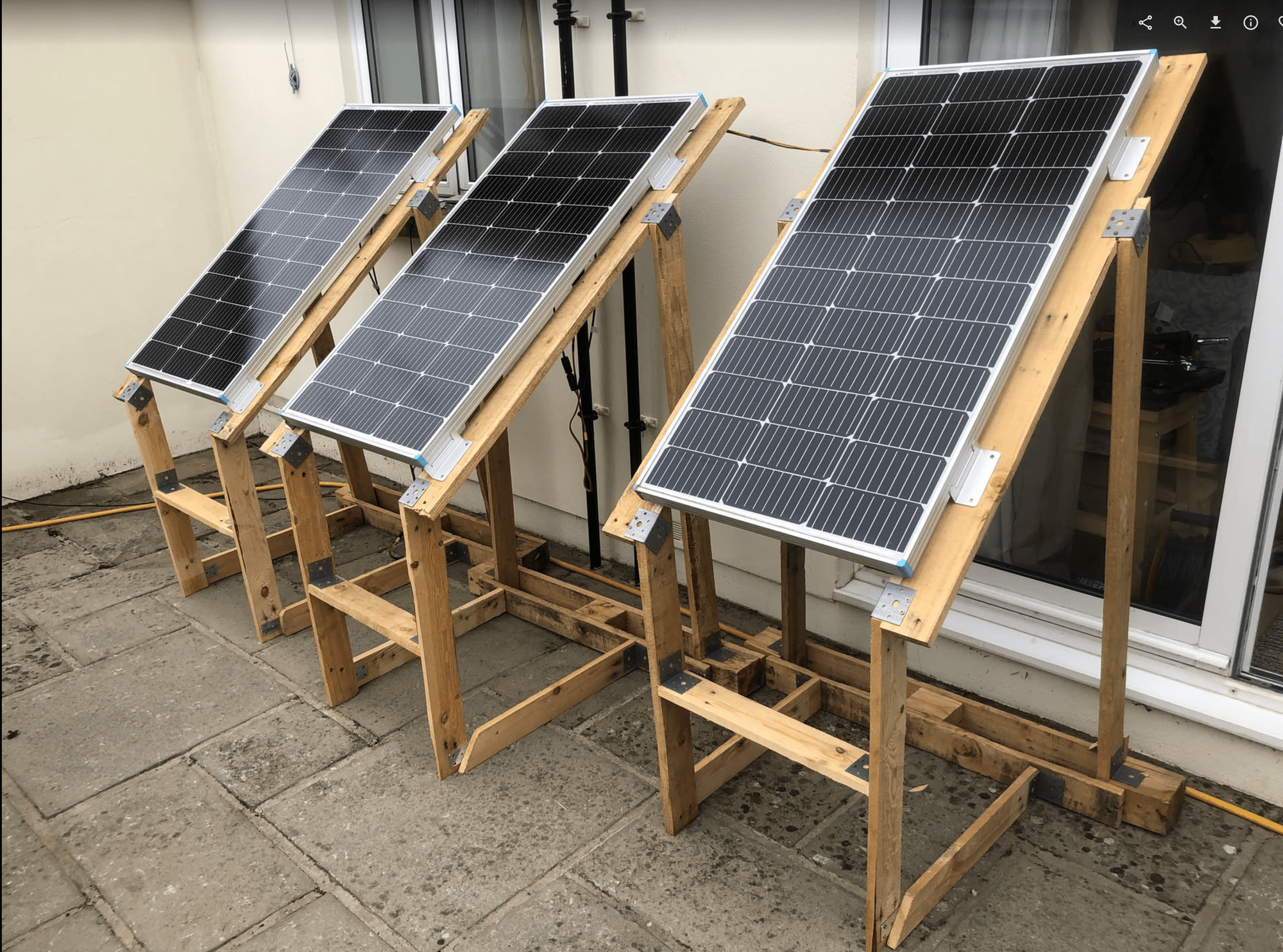
One advantage the PowerHouse had over the current setup was charge speed. The 1.2kWh battery could be fully recharged from empty in around 1.5 hours from a wall socket — useful for topping up quickly if needed. The Fogstar is a different proposition entirely: at 560Ah (6.7kWh), the Fogstar-branded LiFePO₄ charger (14.2V / 50A, 710W output) takes roughly 11–13 hours for a full charge from empty. Not a problem in practice — it charges overnight on cheap Agile slots — but there is no equivalent of plugging in for 90 minutes and being done.
The load it was running was modest: a computer, a monitor, and two small televisions. That was it. The main value was riding out the evening peak — keeping those devices off the main grid during the most expensive hours of the day. Meaningful compared to doing nothing, but still a fraction of the £60–115 combined bills at the time. The 1.2kWh ceiling was always the constraint. The panels could generate more than the battery could hold, and once it was full that was it — no way to store or use the rest. The proper build was always going to be about fixing that ceiling.
On 15 July 2025 I sold the Anker and installed the proper system: four 100W panels at first, ground-mounted on a salvaged-pallet frame in the garden (no roof access in this 1-bed flat), a 6.7 kWh Fogstar Drift LFP battery on a board indoors, with the MPPT and inverter alongside. Nothing fancy. About £2,200 of kit. 23 November 2025 brought panels five and six (600W array), then the seventh panel in late April 2026 (700W).
Reliable logging caught up by August: 25.6 kWh in that first complete month, against ~210 kWh of household load. Useful, not transformative. UK winter is exactly as bad as the brochures don't tell you — December dropped to 4.5 kWh for the whole month.
The smart-meter baseload halved
One immediate structural change the kit made shows up in the smart meter's idle draw — the wattage the meter sees during the deepest part of the night, when nothing is being actively used. Octopus's current_demand sensor has been logging this every minute since June 2025, so the kit-arrival cliff is right there in the data:
| Month | Baseload (W) | Bar |
|---|---|---|
| Jun 2025 pre-kit | 106 | |
| Jul 2025 kit installed 15th | 96 | |
| Aug 2025 microgrid takes over | 43 | |
| Sep 2025 | 34 | |
| Oct 2025 | 36 | |
| Nov 2025 | 37 | |
| Dec 2025 | 39 | |
| Jan 2026 winter bump | 47 | |
| Feb 2026 | 37 | |
| Mar 2026 | 37 | |
| Apr 2026 | 37 | |
| May 2026 fans on | 39 |
The microgrid moved the always-on cluster — desk lights, TV, routers, two micro-PCs, set-top boxes, e-bike trickle charges — off the smart meter and onto the battery. What the meter still sees is the kitchen-side stuff (fridge, vampire loads from the gas boiler and the wider house, anything not on the microgrid). Net effect: the meter's idle wattage roughly halved, and stays there year-round apart from a small winter bump (heating standby) and a small summer bump as fans started in late May.
Solar generation since install, by month:
| Month | kWh | Bar |
|---|---|---|
| Aug 2025 | 25.6 | |
| Sep 2025 | 22.8 | |
| Oct 2025 | 11.4 | |
| Nov 2025 | 7.8 | |
| Dec 2025 | 4.5 | |
| Jan 2026 | 7.2 | |
| Feb 2026 | 8.8 | |
| Mar 2026 | 35.8 | |
| Apr 2026 7th panel | 68.0 | |
| May 2026 | 71.6 |
⚡ October 2025: Octopus Agile
In October 2025 I switched to Octopus Agile — half-hourly variable pricing, including the legendary occasional negative-rate "plunge" slots where Octopus literally pays customers to consume. April 2026 alone had 142 negative-rate slots, with the deepest at -12.05p/kWh. That month my effective rate per imported kWh was 3.91p, vs the cap's roughly 28p. The April electricity bill came in at £8.73, against a counterfactual cap bill of £68.94 for the same usage.
For the first few months on Agile I ran with simple Home Assistant automations that picked cheap slots overnight. It worked, but the corner cases — sunny days, deep plunges, weather forecasts — were left on the table. So in April 2026, when I wrote my first post about how the system manages itself, I started building it properly: a planner project that has been evolving ever since and is still being fine-tuned today.
The planner runs every half hour. Each tick it pulls in tomorrow's published Agile rates (where available) and fboundy's agile_predict forecast for the slots Octopus hasn't published yet, the Solcast solar forecast for the panels, current battery SOC, and a rolling daily-usage average. It then books just enough charging — never a kWh more — at the cheapest moments between now and the next 16:00 publish. The battery covers most house load through expensive hours; the smart meter barely sees usage between 4pm and 7pm.
Across the nine months on Agile the arbitrage slice has accumulated about £70 of pure profit on top of the regular solar/battery savings. Buy cheap, store, use during expensive. Octopus doesn't mind — they're balancing the grid. I don't mind — the bill keeps shrinking and the planner keeps getting smarter.
🌻 March 2026 onwards: Spring turns the corner
The solar bars start climbing fast. March 35.8 kWh, April 68.0, May 71.6 kWh. The seventh panel was added in late April, taking the array from 600W to 700W just as the longer days arrived. Best single day so far: 3.45 kWh, in May. Clear-sky days now sit at 3.3-3.5 kWh, cloudy days at 1.5-2.5.
The May electricity bill was £21.47 — for the same household load as the £55 bill in March 2023. Solar covers about 60% of household demand outright. The battery and Agile together cover most of the rest at sub-15p/kWh.
Solar generates what it generates. The battery and Agile turn the grid from an enemy into a flexible buyer–seller.
2026 so far: usage by month
Zooming in on the current year tells its own story. Grid kWh imported month by month, against direct-load consumption and solar generation:
| Month | Grid kWh | Bar | Solar kWh | Bill £ |
|---|---|---|---|---|
| Jan 2026 | 158.3 | 7.2 | 29.57 | |
| Feb 2026 | 127.5 | 8.8 | 18.24 | |
| Mar 2026 | 176.1 | 35.8 | 24.48 | |
| Apr 2026 plunge | 223.2 | 68.0 | 8.73 | |
| May 2026 | 122.5 | 71.6 | 23.50 |
Reading top to bottom: grid kWh trended down through February (127.5 — the lean month, fewer dark days, no spikes), climbed through March as winter held on, then April looks anomalous at 223.2 kWh. That April figure isn't real demand — it's deliberate consumption during negative-rate slots Octopus paid me to use.
Direct-to-loads alone hit 161 kWh that month — four times the usual — because I deliberately ran appliances during the deepest plunges. The smart meter sees a "spike" that's actually a profit.
May is the cleanest signal yet: 122.5 kWh of grid import, the lowest since February, with 71.6 kWh of solar doing the heavy lifting alongside the battery. May 2025 (pre-solar) was 174.7 kWh for the same flat — so May 2026 is ~30% less grid for the same household. Solar contribution and grid reduction line up almost exactly, which is the cleanest possible signal that every kWh the panels generate gets used.
The bill column tells the parallel story: April's £8.73 was a freak (plunge credits absorbed most of the unit cost), but every other month sits in the £18-30 range — well below the cap counterfactual of roughly £40-55 for the same usage. The Agile + battery + solar combination is now the load-bearing piece of the household energy budget.
That Quiet Blip in January–February 2026
One funny artefact in the gas data: there's a near-flatline from mid-January to mid-February 2026. That's because I was in India for five weeks. Nobody home, heating completely off. Even the data goes on holiday.
Electricity only dropped about 29% — from 5.9 kWh/day to 4.2 kWh/day. The fridge-freezer was off, but vampire loads take their toll — servers, routers and networking equipment ran continuously throughout. Neither cared that nobody was home.
Mid-winter solar is negligible, so every unit going in came straight from the grid. Each night between 1am and 5am — peak Agile cheap window — the battery charged at around 480W. By 6am it switched to discharging and quietly powered the empty flat through the day. 2.3 kWh in, 2.0 kWh out, every single day.
Reducing those vampire loads is a future project. There’s probably a meaningful saving buried in the always-on baseload that’s never been properly audited.
The Price Comparisons
Two benchmarks are worth looking at. The Energy Price Guarantee (Oct 2022–Jun 2023) was the government's emergency cap that held typical electricity at ~34–36p/kWh while the Ofgem cap was heading toward 52–67p. The Ofgem price cap has been in place since 2019 and provides a useful baseline for the full period. Both are hypothetical comparisons against what a default tariff customer would have paid.
Both use approximately 200 kWh/month electricity consumption.
Energy Price Guarantee (Oct 2022–Jun 2023)
| Period | Duration | EPG rate | EPG bill/mo | Actual (Go) | Saving/mo |
|---|---|---|---|---|---|
| Oct 2022–Mar 2023 | 6 months | ~34p/kWh | ~£68 | ~£40–50 | ~£18–28 |
| Apr–Jun 2023 | 3 months | ~36p/kWh | ~£72 | ~£45–55 | ~£17–27 |
Rough saving across the EPG period: approximately £160–230.
Vs Ofgem Price Cap — Full Period
| Period | Tariff | Cap rate | Cap bill/mo | Actual bill/mo | Saving/mo |
|---|---|---|---|---|---|
| Nov 2021–Sep 2022 | Go | 20.8–28.3p | ~£42–57 | ~£28–40 | ~£12–17 |
| Oct 2022–Jun 2023 | Go | ~34–36p (EPG) | ~£68–72 | ~£40–55 | ~£17–28 |
| Jul 2023–Mar 2024 | Go Variable | 27–30p | ~£54–60 | ~£40–50 | ~£10–14 |
| Mar 2024–Jul 2025 | Agile / Cosy | 24.5–27p | ~£49–54 | ~£28–35 | ~£15–22 |
| Jul 2025–Mar 2026 | Agile + solar | 25.7–27.7p | ~£51–55 | ~£12–18 | ~£33–43 |
Rough total over 53 months: approximately £750–1,050 saved against what a price cap customer would have paid. Excludes plunge events, the April 2026 green levy reduction, and peak avoidance.
The Undocumented Saving: Peak Avoidance
The table above captures the difference in average rates. What it does not capture is what the battery actively prevents: buying electricity during the evening peak.
On Octopus Agile the 4pm–7pm window regularly runs at £0.30–0.50/kWh, and during cold high-demand evenings in winter can spike well above £0.60/kWh. A price cap customer pays the same flat rate regardless of the time. An Agile customer without storage has no choice — whatever the half-hourly slot costs, they pay it. With the Fogstar in place, the battery covers the evening peak entirely. It charges overnight at £0.05–0.10/kWh and discharges through those expensive hours without drawing a single unit from the grid at peak rates.
A typical evening shift of 2–3 kWh moves from £0.35–0.50/kWh peak slots to £0.07/kWh overnight storage. That is a saving of around £0.56–1.29 per evening — roughly £17–39/month of pure peak-shifting value, on top of everything else. None of this shows up in a standard payback calculation. The battery is not just storing solar energy. It is actively navigating a dynamic tariff every single day, without being asked.
And then there are the days the bill goes negative. On 5 April the daily consumption charge came in at -£1.64 — not a rounding error, not a credit adjustment, just a day where the combination of solar generation, stored cheap overnight energy and a plunge event meant that more value was received from the grid than was paid for it. Days like that have hit -£1.50 and beyond. The standing charge is still a cost — but -£1.64 consumption minus 54p still leaves the day at -£1.10. The whole bill is negative.
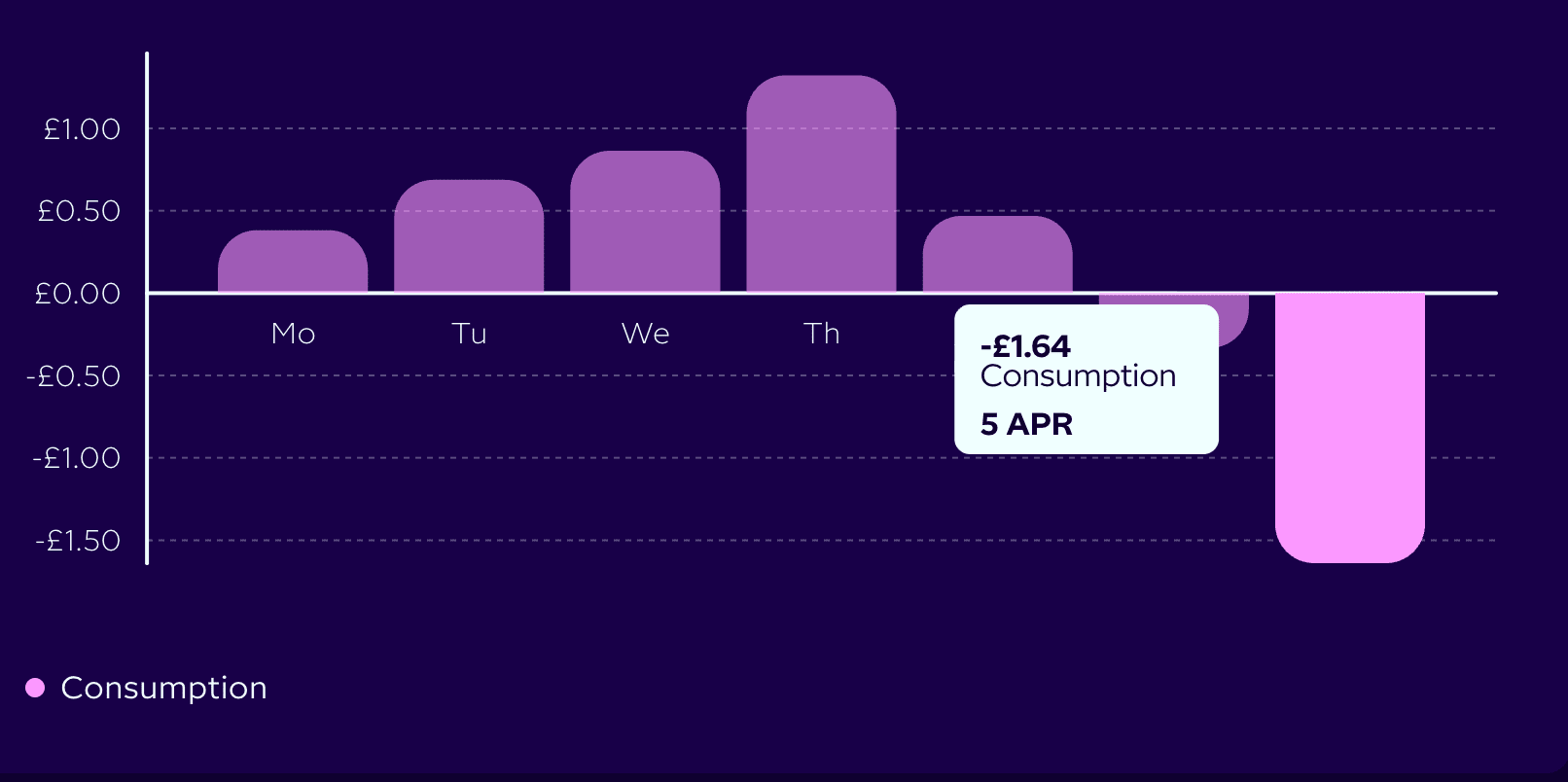
The panels pay back in kWh. The battery pays back in flexibility. The bill pays back in minus signs. I really am Agile.
What the five years actually say
Compressed into one paragraph: cheap energy gave way to crisis, the crisis gave way to a new permanently-elevated normal, and at that point I stopped trying to ride out the wholesale market and bought tools to bypass it. The planner extracts the cheapest possible source for every kWh I actually consume.
Roughly £200 saved against the price cap over the 318 days since install. A modest number in absolute terms, but the curve points down while the world points up. The 7-panel array is at near-peak summer output now; the savings line should climb steeply through to August.
If a war or another wholesale shock happens again — and looking at the geopolitics, it might — the bill chart will still react, but the kit between it and the grid will absorb a lot of the blow this time around. That's what the last bars on the right are showing. That's what cost the kit. That's why it was worth doing.
If you’re on or considering Octopus Energy, the referral link is share.octopus.energy/crisp-bee-8 — both of us get a bill credit.
† Full Octopus tariff history
| From | To | Tariff |
|---|---|---|
| Sep 2021 | Sep 2022 | Octopus Go (GO-21-05-13) |
| Sep 2022 | Sep 2023 | Octopus Go (GO-22-07-05) |
| Sep 2023 | Mar 2024 | Octopus Go Variable (GO-VAR-22-10-14) |
| Mar 2024 | Jan 2025 | Octopus Agile (AGILE-23-12-06) |
| Jan 2025 | Apr 2025 | Octopus Cosy — with brief Agile intervals |
| Apr 2025 | Aug 2025 | Octopus Agile (AGILE-24-10-01) |
| Aug 2025 | Feb 2026 | Octopus Agile (brief Cosy dip Aug 11–14) |
| Feb 2026 | Mar 2026 | Octopus Go Variable / Agile (switching) |
| Mar 2026 | Mar 2027 | Octopus Agile (AGILE-24-10-01) |
Source: Octopus Energy API, account agreements endpoint. Retrieved April 2026.
Standing charges — electricity & gas, all tariffs (inc. VAT, direct debit rates)
| Tariff | SC valid from | SC valid to | Standing charge |
|---|---|---|---|
| Electricity | |||
| Variable (VAR-21-07-02) | Jul 2021 | Apr 2022 | 24.03p/day |
| Go (GO-21-05-13) | May 2021 | — | 25.00p/day |
| Go (GO-22-07-05) | Jul 2022 | — | 41.39p/day |
| Go Variable (GO-VAR-22-10-14) | Mar 2023 | Mar 2024 | 45.57p/day |
| Agile (AGILE-23-12-06) | Dec 2023 | — | 45.56p/day |
| Cosy (COSY-22-12-08) | Oct 2024 | Mar 2025 | 55.79p/day |
| Cosy (COSY-22-12-08) | Apr 2025 | Jun 2025 | 46.98p/day |
| Cosy (COSY-22-12-08) | Jul 2025 | Sep 2025 | 44.78p/day |
| Agile (AGILE-24-10-01) | Oct 2024 | — | 55.79p/day |
| Go Variable (GO-VAR-22-10-14) | Jan 2026 | Mar 2026 | 47.76p/day |
| Go Variable (GO-VAR-26-02-11) | Feb 2026 | Mar 2026 | 47.76p/day |
| Gas | |||
| Variable (VAR-21-07-02) | Jul 2021 | Apr 2022 | 23.85p/day |
| Variable (VAR-21-07-02) | Apr 2022 | Sep 2022 | 27.22p/day |
| Variable (VAR-21-07-02) | Sep 2022 | Mar 2023 | 26.84p/day |
| Variable (VAR-22-11-01) | Mar 2023 | Jan 2024 | 27.47p/day |
| Variable (VAR-22-11-01) | Jan 2024 | Mar 2024 | 27.47p/day |
| Silver (SILVER-23-12-06) | Dec 2023 | — | 27.47p/day |
| Variable (VAR-22-11-01) | Oct 2024 | Mar 2025 | 29.34p/day |
| Variable (VAR-22-11-01) | Apr 2025 | Jun 2025 | 31.07p/day |
| Variable (VAR-22-11-01) | Jul 2025 | Sep 2025 | 28.59p/day |
| Silver (SILVER-25-09-02) | Sep 2025 | — | 32.64p/day |
Source: Octopus Energy API, standing-charges endpoint. Direct debit rates. Retrieved April 2026.