 elyob
elyob
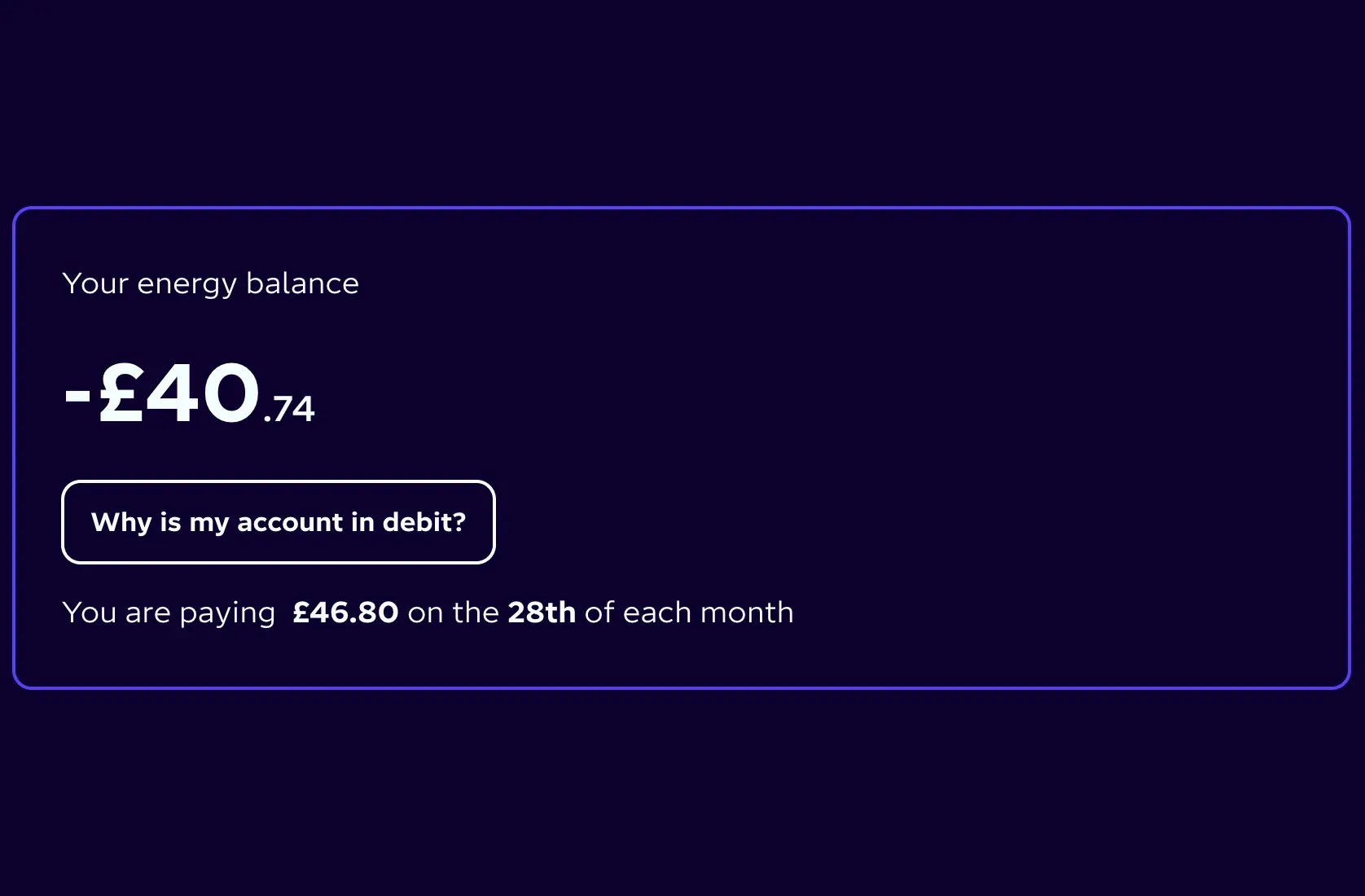
I logged into Octopus this morning to see my balance sitting at minus £40.74 — which is just this month's bill, waiting for the £46.80 direct debit due on the 28th. Routine cycle. Curious about what number Octopus would have me pay if I asked, I clicked through to the adjust-payment page. Their recommended figure: £97.78 a month. More than double.
The adjust-payment page pre-fills its text box with that figure, and crucially, the page won't accept any number below my current £46.80 either. So the only directions on offer are: pay roughly the same, or pay considerably more.
What I actually do is leave the DD at £46.80 and pay the difference by card when a winter bill runs over. Same play I've been running since last summer. Octopus support themselves wrote "nice to see you're consistently topping up with card payments to cover the rest of your bill" in the July 2025 thread — so they know, and they're fine with it.
Last Year, Same Conversation
Last July, Octopus suggested £80 a month. I pushed back. Here was the exchange.
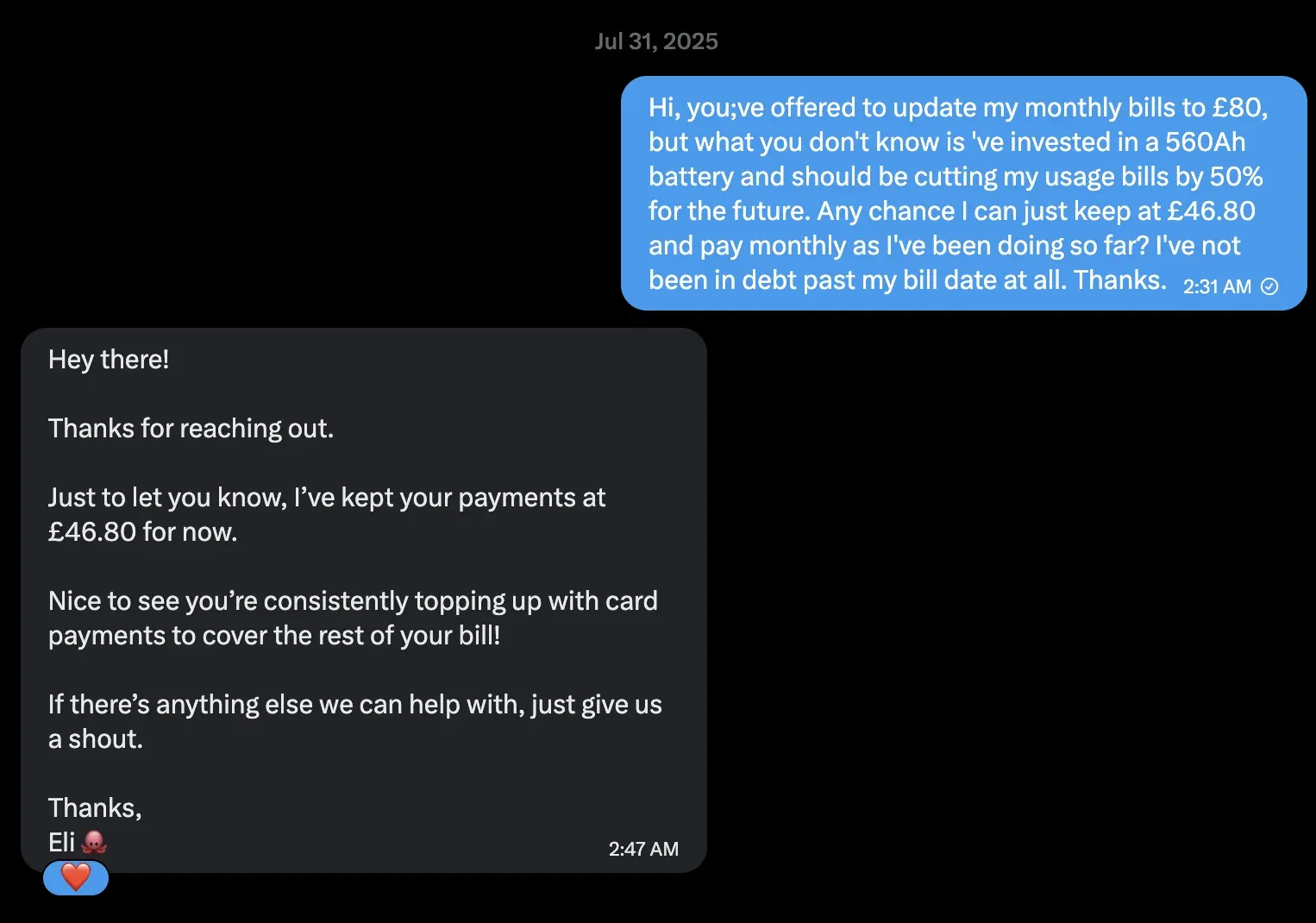
I'd just installed a 560 Ah LiFePO4 battery and was timing grid charges against Octopus Agile half-hour slots. My pitch was a 50% cut in usage bills. Eli (credit where it's due — Octopus support is consistently good) kept me at £46.80 on the strength of that claim.
Twelve months on, I owe Octopus an honest grade on my own promise. Time to do the maths.
Did the Kit Deliver?
Here's where I have to be careful, because the obvious answer — "look at the bills" — gives the wrong number. Both the £46.80 DD and Octopus's £97.78 suggestion are dual-fuel: they cover electricity and gas and two daily standing charges. The battery and solar can only affect one slice of that: the electricity unit cost. Everything else is structural.
So the honest scoreboard for the kit isn't the dual-fuel bill — it's the electricity unit cost versus what the same kWh would have cost on the Ofgem cap. Here's the count since installation on 15 July 2025:
| 9.5 months since install | |
|---|---|
| kWh used | 1,624 |
| Actual electricity unit spend (Agile, with battery arbitrage) | £209.60 |
| Cap counterfactual (same kWh, Ofgem cap rates) | £418.86 |
| Saved on electricity units | £209.26 (exactly 50%) |
| Annualised | ~£264 / yr |
So the July 2025 claim of "cutting my usage bills by half" was correct — on the metric the kit can actually affect. The dual-fuel bill doesn't reflect that cleanly because most of the bill is gas (about £15 a month) and the two combined standing charges (about £27 a month). Those are immovable. The variable slice is tiny by comparison, and on that slice, the kit has done exactly what I told Eli it would.
For reference, the dual-fuel bills since the conversation:
| Month | Bill |
|---|---|
| Aug 2025 | £54.49 |
| Sep 2025 | £60.80 |
| Oct 2025 | £42.10 |
| Nov 2025 | £45.51 |
| Dec 2025 | £74.11 |
| Jan 2026 | £83.72 |
| Feb 2026 | £60.62 |
| Mar 2026 | £62.59 |
| Apr 2026 | £56.16 |
| May 2026 | £40.74 |
| 10-month average | £58.08 |
That £58.08 average is the bill Octopus sees, and it's what their adjust-payment page uses to project forward. They don't see "the electricity unit slice is already halved" — they see the headline number that contains a fixed gas+standing floor of about £42 a month, and project conservatively from there.
So Should It Be £97.78?
No. And honestly, it doesn't need to be any other number either.
Annualised at £58.08 a month, the actual run-rate is £697 a year. Octopus's suggested £97.78 × 12 is £1,173. Between today and next May, that DD would build £476 of credit sitting in their bank account, not mine.
The DD pulls £46.80 every month, on time, no friction. What flexes is a small card payment on top in winter months when the actual bill ran over — just the difference, not the whole thing. The DD does the bulk of the work; the card payment closes the gap. The £40.74 unpaid balance right now is just May's bill awaiting the 28 May DD; that pull will clear it and leave the account £6.06 in credit. No need to renegotiate the monthly figure at all.
The One-Way Text Box
The bit that bothers me isn't the £97.78 number on its own. It's that the adjust-DD page will happily accept any number above my current £46.80 — even far above any honest projection of my usage — but will not accept any number below it. Typing in a sensible lower figure gets rejected.
That's a one-way ratchet. It works fine for suppliers, because customer credit is interest-free capital they get to hold. It doesn't work for customers, because once I've over-committed in a winter month, the only path back down is messaging support and arguing my case.
Anyone running a metered, instrumented setup like mine has the data to counter-propose. But I shouldn't need a 560 Ah battery and a Home Assistant dashboard to negotiate a fair monthly payment. The form should accept both directions.
What I'm Doing
Nothing, basically. Keeping the DD at £46.80. When a winter bill lands above it I top up by card to cover the difference. When a summer bill lands below it, the DD over-pays and the surplus eats away at any small accumulated debit.
That's worked through one full winter already with no drama. The -£40.74 on screen this morning isn't a cumulative shortfall — it's just May's bill sitting against the account, waiting for the 28 May DD to clear it. After that pulls, the account ticks into a small surplus.
The other thing worth noting: May's £40.74 is the lowest monthly bill of the ten in the table above, and for only the second time in that window, the bill came in below the £46.80 DD. The next direct debit will pull more than the bill it's covering. That hasn't happened often — but with the rest of the summer ahead and a 700 W array starting to carry the household load properly, I'm hoping it becomes the normal pattern rather than the exception. From here, the small debit should shrink on its own.
Although the cold, grey, wet Tuesday outside the window today is a useful reality check on that optimism — the panels aren't doing much right now either. "Sunnier months ahead" is the right direction, not a guarantee on any given day.
The Wider Point
Energy suppliers default to suggesting higher direct debits because higher credit balances are good for them. That's not a conspiracy — it's just where the incentive points. The defence is the same as for most defaults: measure my own numbers, and don't accept the first figure on the screen.
The two-screenshot version of this post is: my battery and Agile setup is doing exactly what I told Octopus support it would do — halving the electricity unit cost — and my supplier wants me to almost double a direct debit they've calculated against the wrong scoreboard. I'm doing neither. I keep the DD at £46.80, top up by card when a winter bill lands over, and write it down so the next person who sees a "recommended" figure auto-filled by their supplier knows it's negotiable, and that the right answer comes from measuring the slice the kit can actually affect, not the dual-fuel headline.