 elyob
elyob
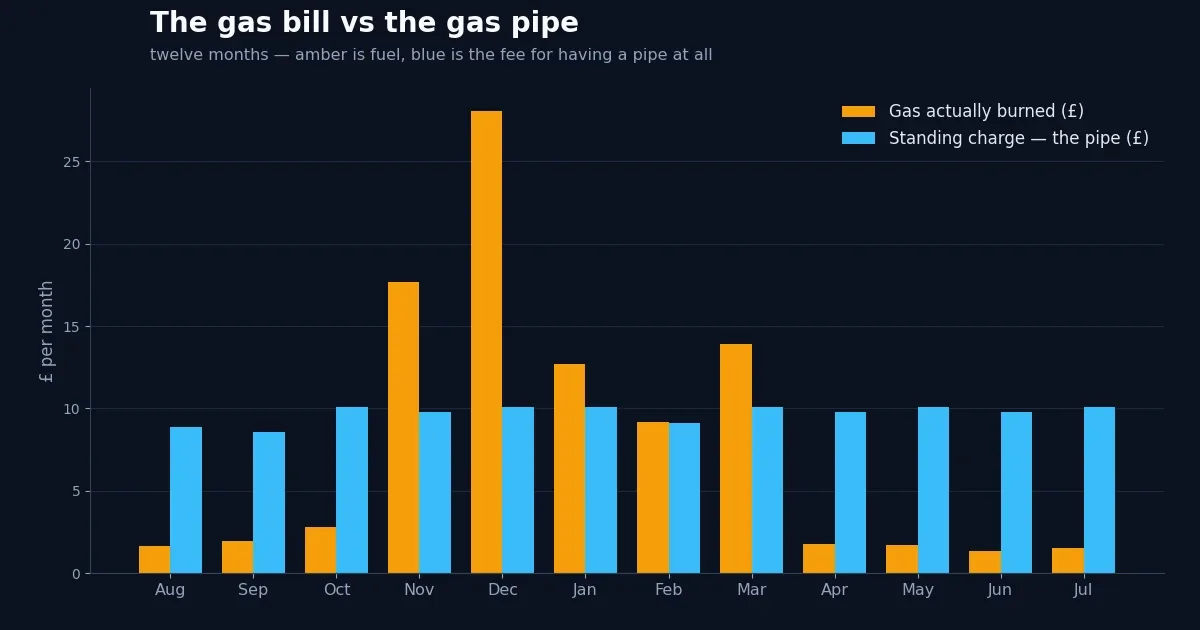
In July I burned 24 kWh of gas — about £1.52 at my unit rate. The standing charge for the same month was £10.12. I paid 6.7 times more for permission to have gas than for gas.
That's July, you might say. Nobody heats a flat in July. So here's the part that actually annoyed me into writing this: it isn't just July. Over the last twelve months — two winters' shoulders and a whole heating season included — I burned 1,495 kWh of gas costing roughly £94, and paid £117 in standing charges for the privilege. The pipe beat the gas across the entire year. In 7 of the twelve months, the fee for the pipe exceeded the fuel that came through it.
The chart makes the shape obvious. Winter puts up three or four honest amber bars — December's heating is real — and the pipe's blue bar just sits there at ten pounds a month, every month, indifferent. April to October the amber all but vanishes and the blue doesn't move. A boiler that runs four months a year rents its pipe for twelve.
Twelve months, fuel vs pipe
| Month | Gas kWh | Fuel £ | Pipe £ | Winner |
|---|---|---|---|---|
| Aug 2025 | 26 | 1.63 | 8.86 | pipe |
| Sep 2025 | 31 | 1.97 | 8.58 | pipe |
| Oct 2025 | 44 | 2.80 | 10.12 | pipe |
| Nov 2025 | 280 | 17.65 | 9.79 | fuel |
| Dec 2025 | 445 | 28.03 | 10.12 | fuel |
| Jan 2026 | 201 | 12.69 | 10.12 | fuel |
| Feb 2026 | 145 | 9.15 | 9.14 | fuel |
| Mar 2026 | 220 | 13.89 | 10.12 | fuel |
| Apr 2026 | 28 | 1.77 | 9.79 | pipe |
| May 2026 | 28 | 1.74 | 10.12 | pipe |
| Jun 2026 | 22 | 1.38 | 9.79 | pipe |
| Jul 2026 | 24 | 1.52 | 10.12 | pipe |
Electricity is heading the same way, but for the opposite reason — and I've written about the 61% before. The gas pipe wins because the fuel barely gets used; the electricity toll is winning because the planner keeps shrinking the fightable part. July's electricity units came to £16.34; the electricity standing charge was about £16.88. April was starker still: £8.73 of units — a plunge-heavy month where Octopus paid me for some of them — against roughly £16.34 of standing charge. The toll booth now costs more than the road, on both fuels.
There's a perverse property in here worth naming: every improvement I make pushes the standing-charge share of my bill up. Better price capture, more solar, smarter charging — the variable part shrinks and the fixed part looms larger. The most annoying number on my bill is, mathematically, a trophy.
Which leaves the genuine decision — and it splits cleanly by season, because the boiler does two different jobs. Year-round it heats water for sinks and showers: the ~24 kWh summer baseline. In winter it also runs the central heating: the ~1,207 kWh seasonal spike above it.
In summer the pipe is indefensible. Spread July's standing charge over July's gas and my hot water costs an effective ~48p/kWh — roughly four times what the same heat costs electrically at full grid price. An electric shower and an undersink heater, about £300 fitted, would fix that permanently. Except they wouldn't kill the pipe. Because winter.
In winter the pipe earns its keep. Those ~1,207 kWh of space heat cost about £76 at 6.3p. Resistive electric would need sub-7.4p power to match that — plunge weather, not January weather — and my 800 W inverter can't carry a heater regardless, so it would be grid at winter spot rates. A heat pump beats it on paper and loses on hardware: install costs push payback past a decade for a one-bed flat. Gas is still the cheapest way to be warm in January.
So here is what the standing charge actually is: not a fee for gas, but a twelve-month subscription to a four-month heating contract — £211 a year all-in for ~£76 of winter warmth and a rounding error of showers. The pipe survives on merit for one season and bills me for four. It should consider itself on notice: one mild winter, one cheap electric-heating experiment that works, and the eviction maths finally closes.
(Gas unit costs above use my current ~6.3p/kWh rate; consumption is metered, from the same records as the gas-vs-electricity year.)