 elyob
elyob
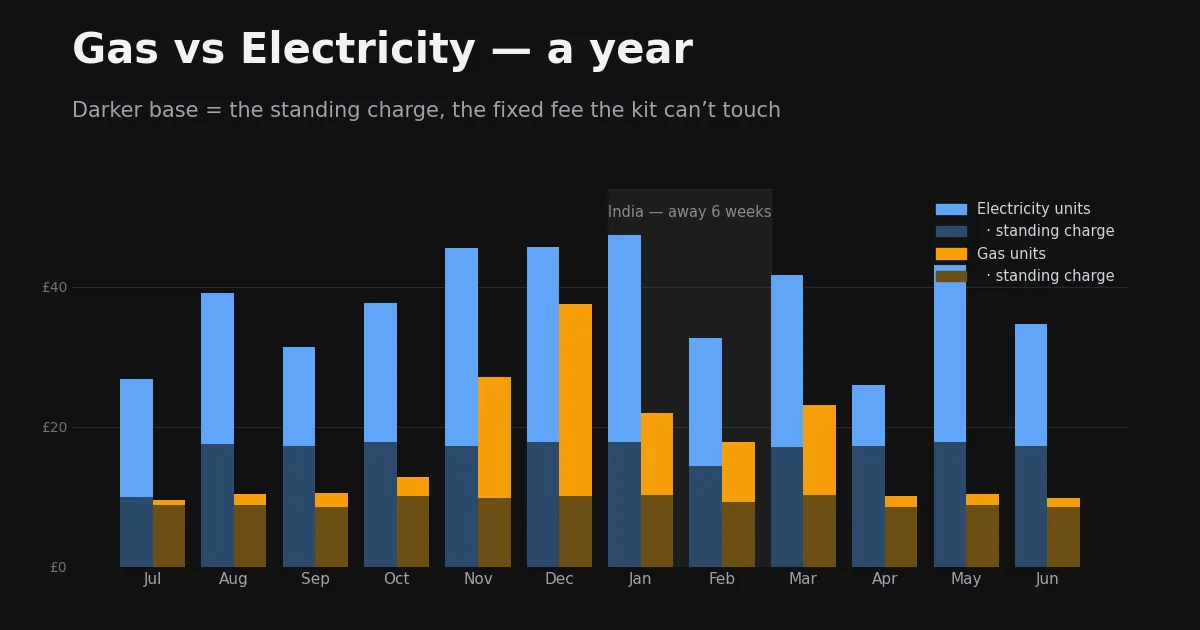
I've written plenty about my electricity — the battery, the half-hourly buying, the planner that shaves it down. But electricity is only half the bill. The other half is gas, and once I laid a year of both side by side, they turned out to behave nothing like each other.
Electricity is remarkably flat. Month to month it sits between £26 and £47 all year round — a bit of weather, a bit of daylight, but no real drama. Gas is the opposite: near enough nothing all summer, about £10 a month for hot water and the odd cook, then it detonates in winter. December's gas came to £37.60, against £9.83 in June.
Add it up and electricity is still the bigger number — £452 across the year against £201 for gas. So gas isn't the cost; electricity is. But gas is the reason winter feels expensive. Electricity barely notices the season while gas quadruples, so the swing in the total bill from summer to winter is almost all gas.
Look at the chart and a second story jumps out: the darker base of every bar is the standing charge — the fixed daily fee I pay before burning a thing. In summer, gas is almost all of it. Across the year the standing charges alone came to £200 on electricity and £112 on gas — meaning more than half my entire gas bill was just the fee for staying connected.
| £452 / £201 | electricity vs gas, over the year |
| 1,899 / 1,481 kWh | electricity vs gas usage |
| £200 / £112 | standing charges alone — before a unit is burned |
| gas −67% / elec −27% | the six weeks I was in India |
There's a neat accident buried in the data, too. I spent six weeks in India from mid-January, and the two fuels reacted completely differently to an empty flat. Gas fell off a cliff — from £37.60 in December to £18 in February — because with no one home the heating simply stopped. Electricity dipped far less, from the mid-forties to £33.
That gap is the whole distinction between the two. Gas here is almost entirely heating, so an empty flat burns next to none. Electricity is baseload — the fridge, the router, the standby draws, the microgrid electronics — and baseload doesn't care whether I'm on the sofa or in Goa. Being away halved the heating and barely touched the rest.
One honest asterisk: my electricity figure is artificially low. The battery and Agile planner have roughly halved what I'd otherwise pay for it, so on a level field electricity would tower over gas even in deep winter.
But that's the point — electricity is the half I can attack, and I've already flattened it. Gas just tracks the cold and whether I'm home; between the weather and a plane ticket, it writes its own bill.
There's one more way gas runs the bill, and it's the one that irritates me most: it sets the price of the electricity I buy, not just the heat. The wholesale market uses marginal pricing — whatever the most expensive plant needed to meet demand costs, everyone pays — and that plant is almost always gas. So even on a blowy day when wind does most of the work, a sliver of gas can still set the price.
That's why my electricity tracks gas even as the grid greens, and it's half of why the battery earns its keep: the arbitrage is partly just dodging the hours when gas is dictating terms. The government reviewed breaking that link and, for now, kept the system, betting that more renewables will loosen gas's grip over time.
Maybe they will. But until gas stops setting the price of electrons it had no hand in generating, cheap wind won't really show up on my bill — and prising gas out of that job would do more for winter than any six-month VAT cut.