 elyob
elyob
On the evening of 12 August the UK caught the partial phase of the total solar eclipse tracking from Iceland down to Spain. I watched it the proper way — from a pub garden, pint in hand. My flat watched it too, in its own fashion: through Home Assistant, which quietly logs the National Grid's generation mix, demand and price every few minutes. A solar eclipse leaves fingerprints all over a power grid, and my little sensor database caught every one of them.
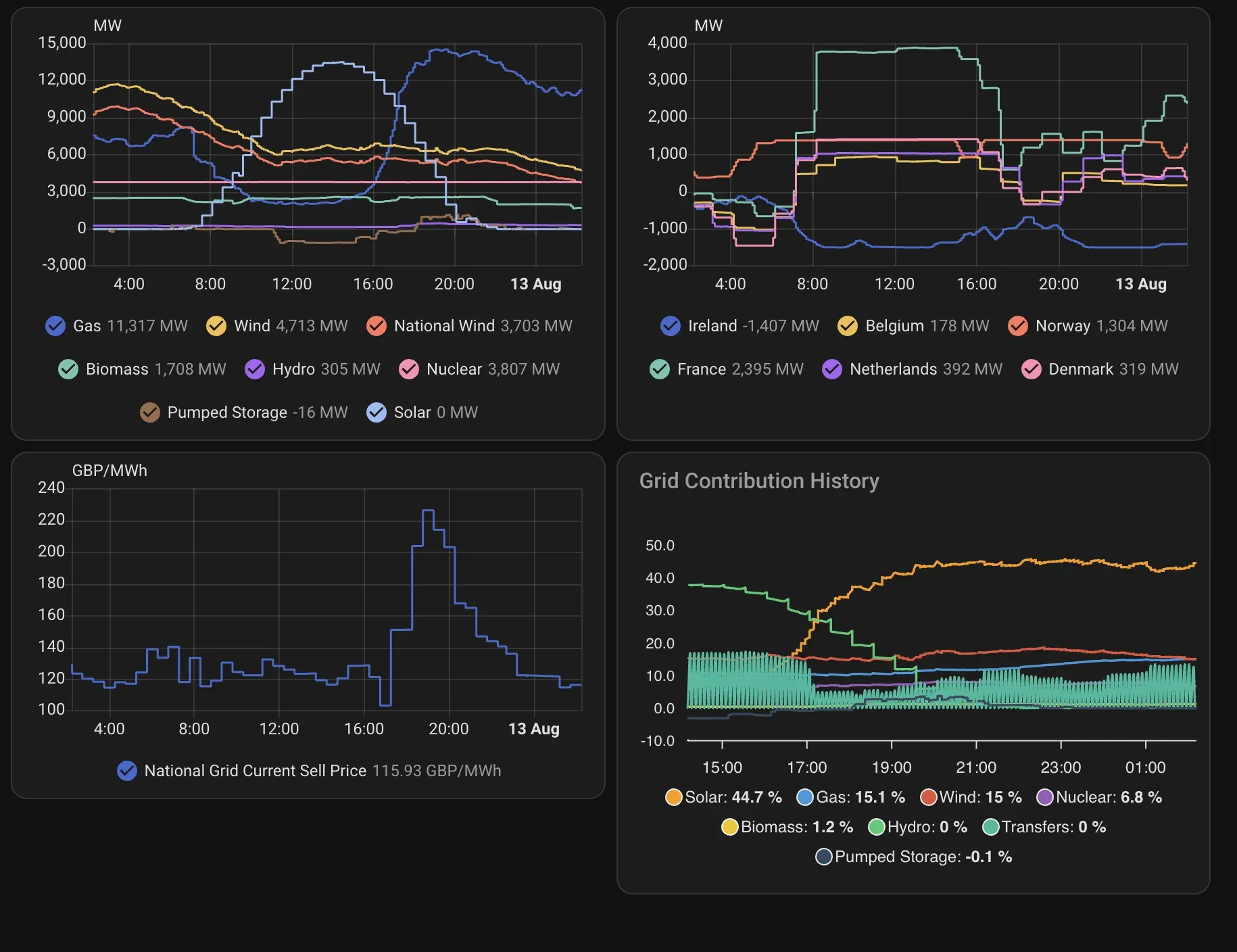
One thing to flag first, because it caught me out: the National Grid generation feed timestamps its data about an hour behind real time. The eclipse actually peaked at 19:12 BST (Royal Observatory Greenwich); in the raw logs, and on the charts below, the solar dip lands around 20:00. I've written the real times here and left the screenshots as the feed recorded them — so knock about an hour off any clock you see on a chart. The price feed, oddly, runs closer to real time.
The solar collapse
GB solar had been tracking the previous evening's sunset ramp almost perfectly. Then, from around 18:15 as the eclipse bit, it fell off a cliff (real times):
| Time (BST) | Solar, 11 Aug | Solar, 12 Aug | Deficit |
|---|---|---|---|
| 18:00 | 4,655 | 4,204 | −10% |
| 18:30 | 3,572 | 1,975 | −45% |
| 19:00 | 2,249 | 553 | −75% |
| 19:30 | 1,308 | 859 | recovering |
At the worst point, right on the 19:12 maximum, roughly 1.7 GW of solar was missing versus a normal evening.
The smoking gun is that last row. Solar output rose between 19:00 and 19:30 — from 553 MW back up to 859 MW. With the sun still well up and more than an hour from setting, panels only brighten again for one reason: the moon sliding off them. That's the eclipse clearing past its maximum.
Who picked up the tab
The grid can't just shrug off a couple of gigawatts, so three things happened at once:
- Gas ran at ~14.3 GW through the eclipse, versus ~10.9 GW the previous evening.
- Pumped-storage hydro — the grid’s classic short-notice plug — ramped to a peak of ~1 GW around the solar minimum, double the previous evening and landing right on the trough.
- Imports from France ran at 1–1.5 GW, versus 0.4–0.7 GW the night before.
Fair caveat: the 12th was also a hot, tight day (demand ran 1–3 GW higher all afternoon), so not every gas megawatt belongs to the eclipse. But the pumped-storage spike sitting exactly on the solar trough is not a coincidence.
And the market noticed. The grid sell price sat around £115–150/MWh all day, then spiked to ~£226/MWh at about 18:45, as the eclipse deepened toward maximum — roughly double — and eased back over the next couple of hours. Evening peaking plant is expensive, and every megawatt of missing solar had to buy some.
The demand shelf
The subtlest fingerprint is on the demand side. This is transmission-level demand — what the big grid sees, after everyone's rooftop solar has quietly self-supplied their homes. On a normal summer evening it falls smoothly from the tea-time peak into the night.
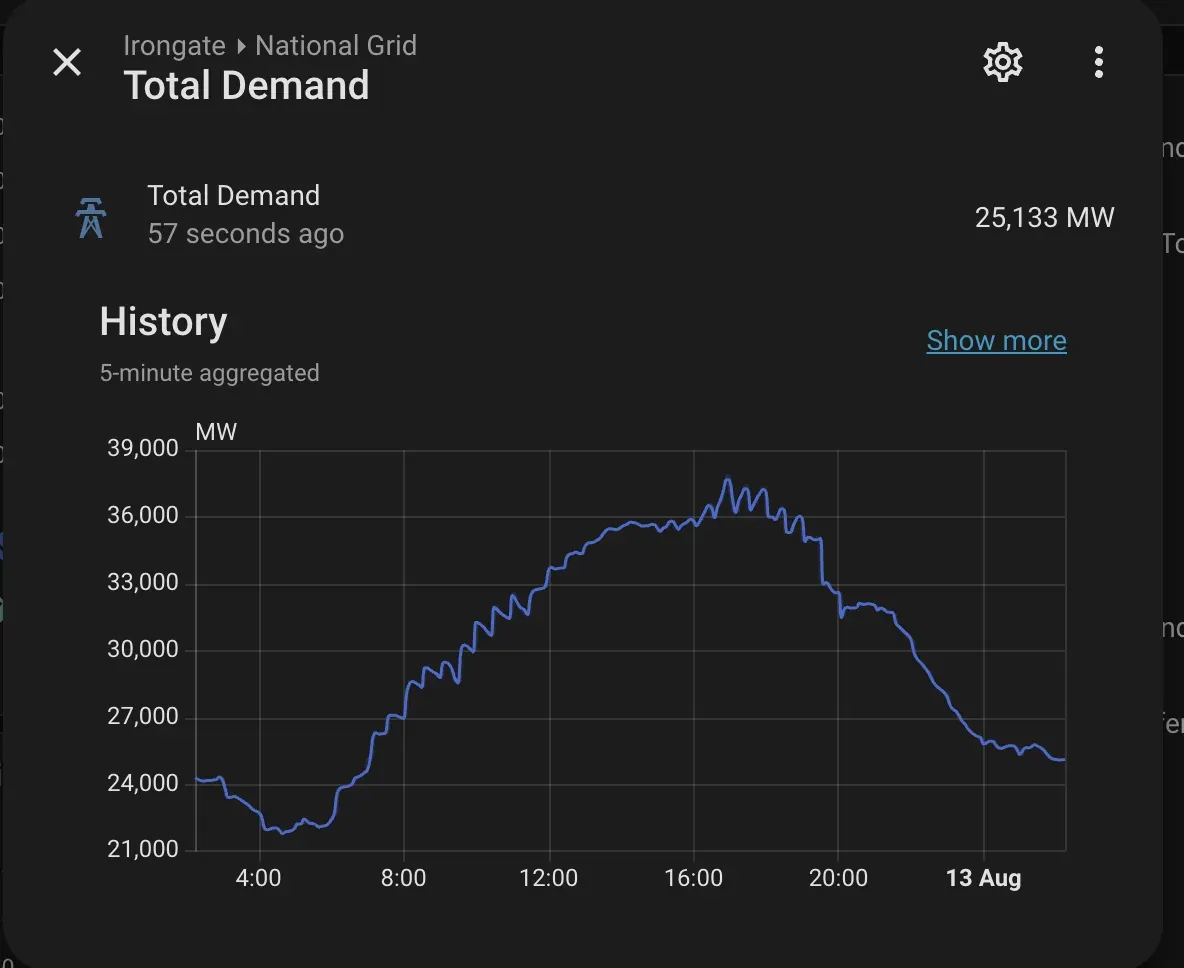
Not on eclipse night. Demand drops steeply from the ~37.7 GW peak, then flattens into a distinct shelf at ~32 GW for about an hour — really around 19:15 to 20:30 — before resuming its slide. That shelf is millions of homes whose rooftop panels went dark at once: houses that had been invisible to the grid suddenly drawing from it, propping the curve up for an hour — exactly the window where grid solar bottomed out and recovered.
The previous evening, the same stretch of curve is a smooth, uninterrupted fall.
Did anyone actually use less?
Octopus Energy had asked households to go easy between 6 and 8pm — shift the washing machine and dishwasher out of the window — with a free hour of electricity and an eclipse photo competition on offer, because the grid operator reckoned around 1.3 GW of solar would vanish at the worst moment.
Did it show? Not in the demand figures. Across the eclipse window, transmission demand ran 1.3–1.5 GW higher than the same clock the night before — the opposite of a mass switch-off. But that's mostly the rooftop-solar effect in reverse: millions of homes whose panels went dark stopped self-supplying and leaned on the grid instead, on an already hot evening. Any careful trimming of dishwashers was swamped, and can't be teased apart from it. The grid never saw a collective step back — if anything it saw more load.
My own flat barely twitched. About 43 W from the grid right through the eclipse — a shade under the 51 W of the night before, and both just the standing baseline. Indoors, nothing changed; local usage simply doesn't reach the meter. The flat runs off stored power, so the grid barely sees me whatever's switched on — a permanent version of the two-hour power-down everyone else was asked for.
A million homes, dimming together
The shelf has a size. About 5.7% of UK homes now have solar — roughly 1.65 million households — but only around a fifth pair it with a battery. That leaves somewhere near 1.2 to 1.3 million homes running solar without storage.
That's precisely the population that lost its self-supply the moment the sky dimmed, and leaned on the grid instead — the shelf, made visible. The ~330,000 homes with a battery are the minority that sat it out, stored power not caring where the moon is.
And not everyone was a drain. Some homes fed the grid rather than drew from it — a slice of those battery households run export tariffs that dump their store into the evening peak, output unbothered by the eclipse. They were a small, steady counter-current, feeding in right as the price spiked to ~£226/MWh, and getting paid for it — the reward a self-supply flat like mine quietly declines. Nowhere near enough to outweigh a million homes swinging the other way, but a current against the tide.
It won't stay this lopsided. MCS certified a record ~257,000 installs in 2025, up a third on the year before, with batteries being added faster than ever. Run the same eclipse a decade from now and the shelf should be visibly flatter — more homes carrying themselves through the dark on yesterday's sunshine, fewer falling back on gas.
The whole story in one paragraph
Supply lost ~1.7 GW of solar over about ninety minutes; gas, pumped storage and the French interconnector filled the hole; the price doubled to ~£226/MWh as the eclipse deepened; and national demand briefly rose against its evening trend as the country's rooftop panels dimmed together. Then the moon moved on, the panels came back for one last stretch before sunset, and everything relaxed to normal.
All of it captured by a Home Assistant box in a cupboard, logging sensors it was never specifically asked to point at an eclipse — and quietly powering the flat through the whole thing while I was out watching the real one. Sometimes the best observatory is the one already humming in a cupboard.