 elyob
elyob

A year ago, a handful of panels on pallet frames in the garden logged their first kilowatt-hour. Twelve months on the tally is 452 kWh — from a ground-level array behind a one-bed flat, through a full British autumn and winter. Not a fortune in electricity, but a real one, and almost all of it landed in the brighter half of the year.
A fair caveat on the anniversary: this isn’t my first solar. An Anker power station chipped away before it — but this is the first year I could actually measure anything. The Anker gave up no data, so I ‘logged’ it by aiming a camera at its screen and letting a fingerbot jab the button to wake the reading. This array is the first that simply tells me.
It wasn’t the same array all year, which matters for reading the numbers. It started as four 100-watt panels last August. Two more went up in late November, and a seventh at the end of April — 400 watts grown to 700 across the twelve months. The dark months ran on four to six panels; only the bright months had all seven.
So the year’s shape is season and hardware pulling the same way. Monthly yield climbed from a December floor of 4.5 kWh to 89.8 kWh in July — partly the returning sun, partly July simply having more panels than December did. A clean year on the settled 700-watt array would read higher right through the winter.
The best single day was 3.54 kWh, on 27 July. That peak tracks the build almost step for step: four panels topped out near 2.17 kWh, six reached 3.12, seven pushed to 3.54. The seventh added only a few percent, though — 700 watts into a 100/50 controller brushes its ceiling at midday, and clips the bit that won’t fit through.
Two honest dents in the record. Eleven days are missing outright — a February logger outage where the counter froze, not dark days, so they sit blank rather than counted as zero. And 132 of the days that did log made under half a kilowatt-hour: a garden array in a grey winter mostly bides its time.
Made, bought, and what it cost
So how does making stack against buying? Not close: over the year I generated 452 kWh and bought 1,925 from Octopus — far more used than the panels make. Though over half that import, 1,071 kWh, was the battery banking cheap and plunge-priced power for later, not the flat drawing live.
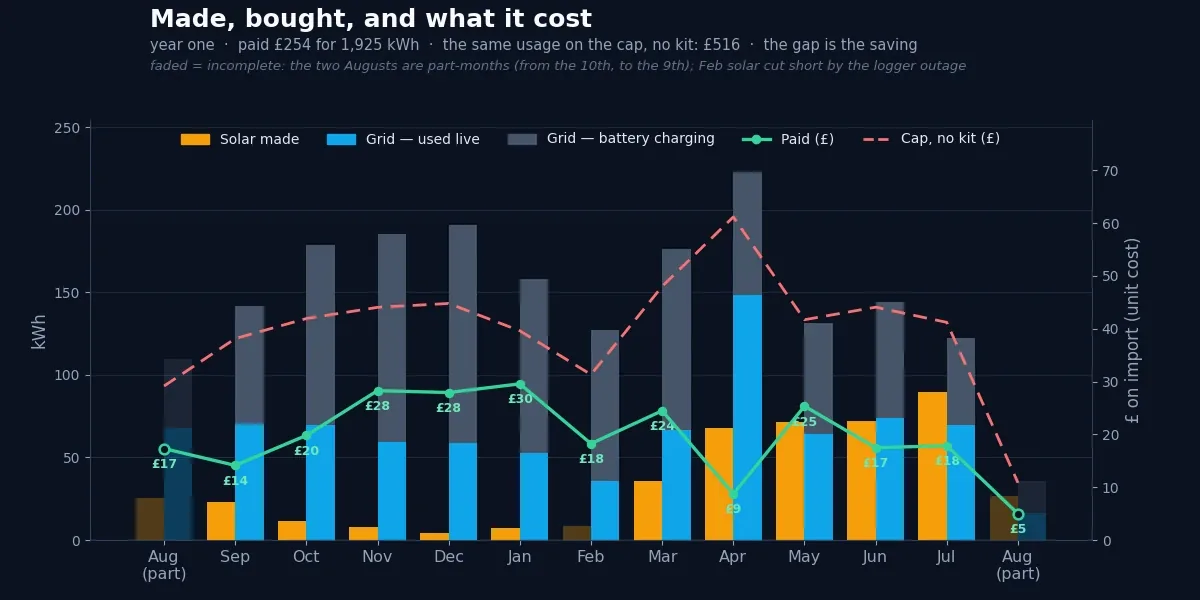
Strip the battery out and the grid actually ran the flat on 854 kWh. Against that the panels’ 452 is a real dent — and in May, June and July their output matched or beat what the grid supplied, before the dark half put them firmly back in their place.
And what it cost makes the case. £254 for the year’s 1,925 kWh — about 13p a unit against a price cap near 26p. April pulled the most power, 223 kWh, yet cost £8.73, because the battery buys when Agile prices go negative. The same year on the cap, without the panels or battery, would have cost about £516 — the kit halved the bill, through the greyest year a garden array will ever see.
Plenty went wrong on the hardware, too. The battery charger died inside a fortnight and went back under warranty. Then the cheap busbar tying the DC side together started running hot — hot enough that I ripped it out for proper Victron 250-amp busbars and thicker cable. Bargain Amazon kit, bought once and paid for twice.
That scare rewired how I watch the thing. There are now temperature probes on the MPPT and a busbar cable, feeding Home Assistant, with an alarm that shouts if either climbs toward trouble. Keeping an eye on the inside of my own wiring wasn’t in the plan a year ago.
The money, honestly, isn’t the panels’ to claim. Solar is the cheap, easy part; the real return comes from the battery hoovering up cheap overnight power, not the sun. Against the price cap the whole kit is on track for a payback of about 9.6 years at the rate so far — a year in, 11.5% of it recovered — the full sum in its own post.
Nowhere near off-grid, and that was never the point. For a small, ground-level, behind-a-flat array that spent half its first year still growing, 452 kWh is a year I’ll take — and year two opens with all seven panels already up.
Which points at what year two is really about: smarter placement, not more panels. Buying small, a few at a time, was as much cashflow and learning as plan — but it left me with an array I can spread and re-angle to flatten the midday spike the controller can’t swallow, chasing a smoother day rather than a bigger peak. A spare charge controller sits boxed for exactly that.
Beyond the garden, plug-in “balcony solar” — minus the balcony — becomes legal to buy and self-install in Great Britain on 27 August, under Statutory Instrument 2026/848. That turns it from a grey-area punt into a real plan, once I find it a spot: panels feeding the flat, and a smart plug diverting the surplus into the battery when the flat isn’t using it, rather than back to the grid.