 elyob
elyob
I've started dismantling my own television setup a few years ahead of the country. The satellite box went first — I sold the Freesat receiver, because the satellites it talks to are on borrowed time. The Freeview boxes were meant to follow. Then I stopped, because I couldn't work out what actually replaces all this. Or, put another way, what wins.
“Telly moves to the internet” isn't an answer — the internet is just the pipe. The real question is what fills it, who controls it, and whether the thing that emerges beats the free, open, absurdly robust broadcast system we're busy switching off. On current form, I'm not convinced.
I'm not new to this — if anything I was an early true believer. A quarter of a century ago I signed up to HomeChoice, Britain's first proper broadband TV service, piped down an ADSL line from a building in Shepherd's Bush and bankrolled by Chris Larson, one of Microsoft's earliest men, alongside Sony and Disney. I was thrilled: films on demand, down a phone line, in the year 2000.
I only ever used that first incarnation — the service went on to become Tiscali TV, then TalkTalk TV, then a memory, without me. But I've watched the idea of internet telly almost-arrive ever since; twenty-five years and a dozen owners on, and it still can't quite do what an aerial and a Humax manage without thinking.
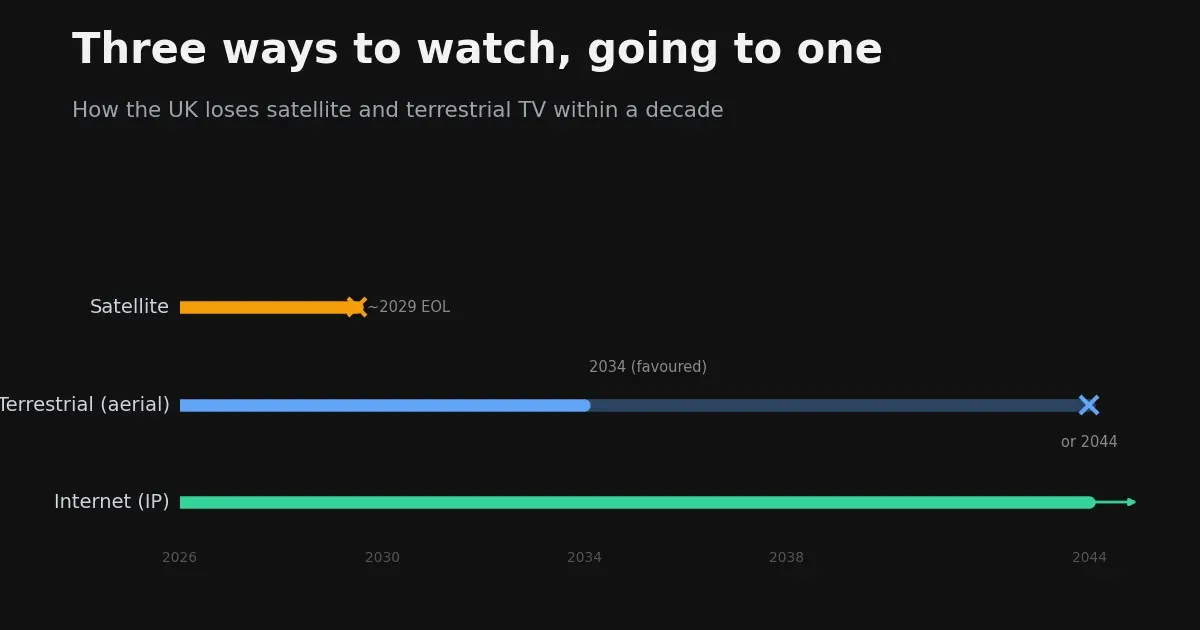
The pipe part is settled. Satellite goes first, quietly: the Astra satellites carrying Sky and Freesat to Britain launched in 2012–14 with fifteen-year lifespans, so they hit end of life around the end of this decade — and SES has ordered no replacement for the 28.2° East slot the UK uses. Sky's contracts run to 2029.
Which is exactly why Sky has spent the last few years quietly herding its own customers onto Sky Glass and Sky Stream, its internet boxes. With no replacement satellite on order, Sky can read the orbital calendar as well as anyone — and it would rather migrate its base to IP on its own terms than watch the dish go dark on someone else's schedule.
Terrestrial is slower and noisier. This summer's green paper proposed switching off Freeview — the aerial signal — in either 2034 or 2044, ministers favouring the earlier date. Put the two clocks together and within a decade Britain goes from three independent broadcast paths to one: every channel, every household, down the same broadband.
The “why” is spectrum. The airwaves Freeview uses are prime low-band — long range, good through walls — exactly what mobile networks covet; the 700 MHz slice already went to 5G and the rest would follow. Which would land better if the 5G we were sold last time had shown up, rather than “connected” bars that won't load a page.
| Satellite TV | Sky & Freesat signal ends ~2029 as the Astra fleet dies |
| Terrestrial TV | Freeview off the aerial — proposed 2034 or 2044 |
| The boxes | dishes, receivers, Freeview PVRs (Humax, YouView) obsolete |
| Recording | the IP replacement (Freely) is live-only so far |
| Open hardware | “any box, any maker” gives way to per-platform kit |
So IP wins the delivery war. The real fight is inside it: what kind of television wins once everything's a stream — and there the picture's a mess. Broadcast was gloriously open: any aerial, any box, one standard, free at the point of use. What's replacing it is a dozen subscriptions, each in its own app, on its own walled-garden hardware.
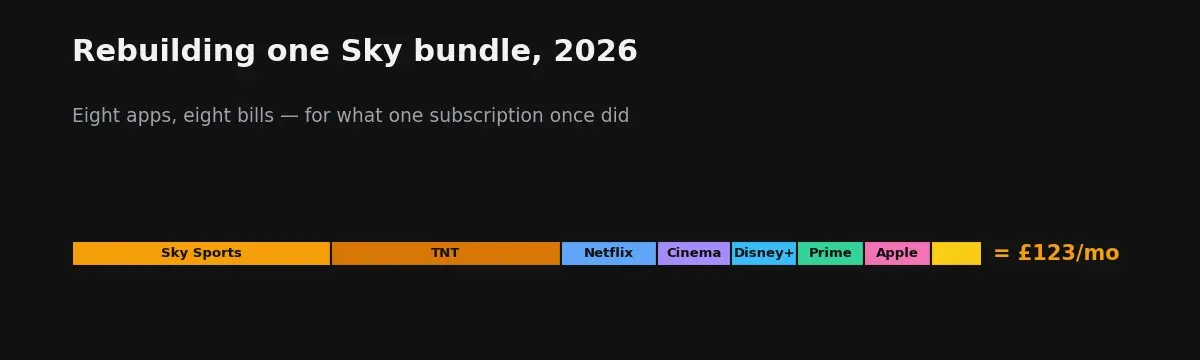
Which quietly broke the single Sky. There used to be one company you paid for effectively everything, on one bill, through one box. Now no provider has it all — the rights are scattered on purpose — and rebuilding that breadth à la carte runs north of £100 a month across seven or eight bills that each rise when they like. Cord-cutting was sold as cheaper; for breadth it turned out dearer.
Sport bites hardest, because the rights are the most deliberately scattered. Following football means Sky Sports and TNT and, for some games, Amazon — three subscriptions for one sport. And it keeps drifting off the free channels: the Tour de France, live and free on ITV for decades, went to TNT for 2026, with only highlights left on Channel 5.
The supposed safety net is the “listed events” — the Crown Jewels the law keeps free-to-air, like the World Cup, the Euros and the Wimbledon finals. But that list has barely changed in decades: the Champions League final isn't on it, most live football isn't, the Tour now isn't. The protected island keeps shrinking, and nobody's topping it up.
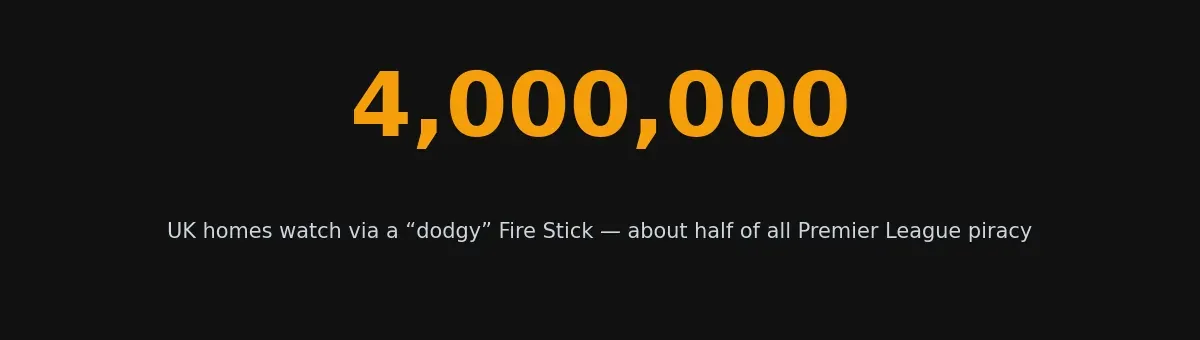
Which is why the fastest-growing “platform” in Britain isn't a platform at all. Police reckon four million UK households watch football, films and boxsets through “dodgy” Fire Sticks — Amazon streamers reloaded with pirate apps — and Sky's own executives put them at roughly half of all Premier League piracy.
Four million homes haven't fallen for a scam; they've done the maths on fragmented, dear legal streaming and opted out. Amazon is trying to shut the door — a locked-down stick that can't sideload, plus blocking on the old ones — but nobody reaches four million households by accident. Piracy at that scale is a verdict on the legal market, not a policing problem.
And the one big free, open service is narrowing its own door. The BBC — 23 million licences and falling, £121 million in the red, its own risk assessment calling the funding model unsustainable — is openly weighing whether to lock iPlayer to licence-fee payers, and to tie online accounts to home addresses to catch evaders.
I understand the arithmetic. But firewalling the one free, universal thing in the landscape, to chase people who've stopped paying, mostly teaches the rest of us that even the BBC is now a walled garden with a bouncer — and pushes yet more households toward the Fire Stick.
Underneath it all sits the resilience question nobody's answering. Three paths was wasteful but robust: when the broadband died the aerial still worked; in a power cut a battery radio and a rooftop signal still got the news out. One pipe is efficient until it fails — and 1.5 million households are still on the aerial, with no plan for emergency news when broadband and power go together.
If this sounds familiar, it should. Britain spent fifteen years promising to kill FM radio for DAB, and FM is still here — guaranteed to at least 2030, the switch-off forever one review away — because pulling a free service the old and the rural rely on proved politically radioactive. Terrestrial TV is walking into that same argument, and my money says its date slides too.
For all the griping, one part of this I'd take tomorrow: the end of SD. Freeview still wastes spectrum carrying standard-definition simulcasts of channels that already broadcast in HD, and the coming shake-out — fewer multiplexes, an HD-native IP tier — is exactly what finally kills them off. HD-only, as a minimum, is the one upgrade in all this I'd switch to without a second thought.
| IP | wins delivery — within a decade, no contest |
| £123/mo | to rebuild one old Sky bundle across 8 apps |
| Sport | split across Sky, TNT & Amazon; even the Tour left ITV |
| ~4 million | homes on “dodgy” Fire Sticks (≈half of PL piracy) |
| iPlayer | BBC weighing whether to lock it to licence-payers |
So what wins? The pipe question is easy — IP, within a decade, no contest. The one that matters, what kind of television Britain ends up with, is uglier. On the current trajectory the winners are the walled gardens and the pirates: paid platforms that each own a slice and lock viewers to their hardware, and a black market four million homes have already joined.
The loser is the thing broadcast quietly was — free, open, universal, hard to switch off. It needn't end there: a properly funded, genuinely free IP service — Freely done right, an iPlayer that stays open — could keep the best of it alive without the satellites and masts. But that's a choice, and nothing about how this is being run suggests anyone's making it.
And even that free future is gated. Freely, the supposed successor, is baked into new smart tellies — it can't be dropped onto an old set the way an aerial plugs into anything with a tuner. Anyone who won't buy a new TV isn't handed the open future; they're left with the free ad-supported reruns their old box already carries, a wall of Frasier. An aerial never cared how old the telly was.
Which is why my Humax is staying exactly where it is, faithfully recording everything the aerial still carries — even if, these days, that no longer stretches to the football — until the future of television is one I'd actually want to switch to.