 elyob
elyob
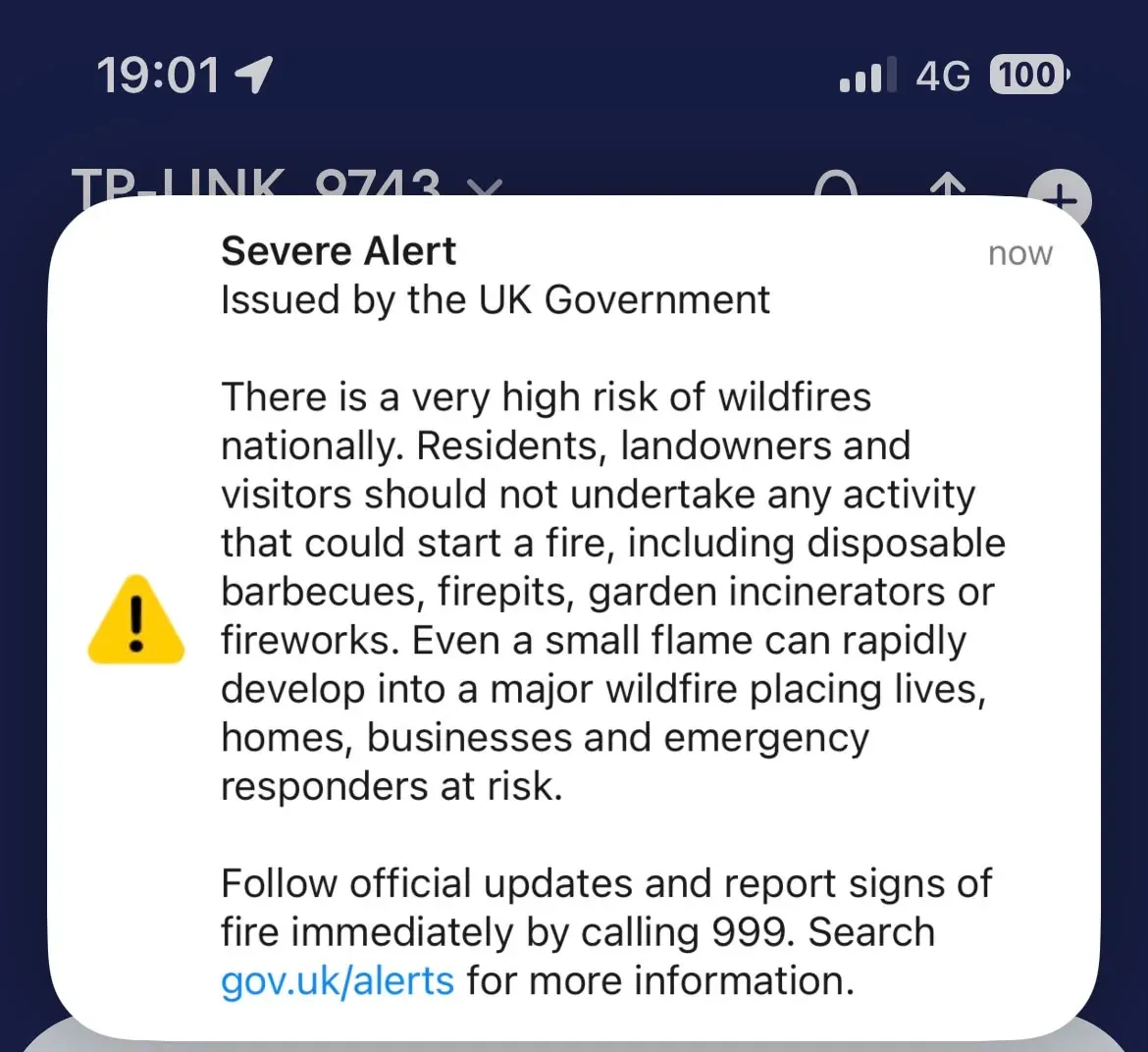
First pint of the Friday night, earphones in, noise cancelling sealing the world out, chilled John Martyn in its place. Then the peace detonated — the siren punching straight through it all, vibration, the yellow triangle filling the screen. A government emergency alert, the same channel held back for floods and life-threatening weather, and it had exactly one thing to tell me: don’t light a portable barbecue.
I haven’t used one in years — they were rubbish anyway — and I was in a pub garden, pint in hand, nowhere near a fire. The same message reached roughly forty-four million phones at once.
Two words on that screenshot are doing more work than the government probably intended: Severe Alert. That’s iOS reporting the severity class the alert was broadcast on — the lower of the two tiers, and the one people are statistically more likely to have already switched off.
The government coded a national behavioural advisory as Severe and sent it to the whole of England and Wales. I want to work through why I think that was a mistake, and why I don’t think it was a stupid one.
What happened
The Cabinet Office sent the alert on a rolling basis from about 19:00 on 14 August to England and Wales. The government’s own log timestamps the send at 7:01pm — the 19:01 frozen in the status bar of my screenshot. Cabinet Office Minister Louise Haigh described it as the most extensive use of the emergency alert system in response to an active incident, and the government was careful to say the request came directly from Fire and Rescue Services rather than from ministers.
Two messages went out, not one — English and Welsh, because statute gives Welsh equal status. But the system can’t broadcast both at once, so it fires them in sequence, and in Wales the Welsh version led the English by a full four minutes — long enough that some in North Wales reached for Google Translate to read an emergency warning.
And the gap is the real fault, not the blanket. Welsh rightly goes to all of Wales — equal status isn’t something to geo-fence to the Welsh-speaking north and west, and speakers are dispersed anyway — so for four minutes much of the country, more than four in five of them non-Welsh-speaking, held an emergency it couldn’t read.
Splitting the two even breached the government’s own Welsh-language scheme, the rule meant to guarantee equal treatment. Some spacing is unavoidable — a phone can’t sound two takeover alerts at the same instant — but four minutes isn’t spacing, it’s a gap wide enough to read as a second, separate emergency.
The context was genuinely grim. Nearly 600 fire detections across the UK in 48 hours. Nineteen homes destroyed at Stourbridge. Around 37 fires burning. Two hundred military personnel deployed to South Wales. An immediate ban on the sale of disposable barbecues, with retailers told to pull them off shelves that afternoon. Nobody sensible is arguing there wasn’t a serious situation.
The four criteria
Emergency Alerts has published thresholds. Lives at risk. Urgency. Action needed. A defined location of the risk.
The location objection is the weakest of the four, and worth being honest about. “England and Wales” is a defined location — and this summer it’s a defined location of the risk, too. The whole country is a tinderbox; anyone who’s watched their sunflowers crisp in the drought knows how national the danger genuinely is. So location isn’t where this alert strains. Action needed is.
For the overwhelming majority of recipients — flat-dwellers, people at work, anyone without a garden or a firepit — there was nothing to do. The message was a public information campaign delivered down an emergency channel, which is a different thing from an emergency.
That’s the objection in one line. The version I find more troubling takes a bit longer.
What didn’t get an alert
I’ve been following the New Forest fire, because I know that landscape and because the scale of it is easy to miss under the Stourbridge coverage.
It started at about 5:20pm on Sunday 9 August, when a van caught fire on the A31 and the blaze spread into the heathland. By Friday it had burned roughly 1.6 square kilometres — one hundred and sixty-nine fire appliances, close to ten thousand firefighter hours — with the A31 shut both ways since Sunday, now closed until at least 20 August, hoses laid across residents’ driveways and livestock loose on the diversions.
Six days of active major incident. No emergency alert. Not one.
Here’s the detail I keep coming back to. On Friday lunchtime, with wind pushing smoke across the area, Hampshire Fire advised affected residents to close their doors and windows.
Defined location. Urgent. A specific action the recipient can take. Health consequences for anyone with a respiratory condition. That is three or four of the four criteria, and it went out via a Facebook post and a National Park webpage.
Six hours later the same government broadcast a barbecue advisory to England and Wales.
The system only has one gear
I don’t actually think this is a story about ministers wanting a photo opportunity, though the alert did land the same afternoon as the PM’s Stourbridge visit, the funding package, the military deployment and the barbecue ban, which is not a great look.
I think it’s a design problem.
Most mature alerting regimes have two tiers. California runs Evacuation Warning, then Evacuation Order. Australia runs Advice, then Watch and Act, then Emergency Warning. The lower tier exists for exactly the case where something is coming but hasn’t arrived: get the documents together, fuel the car, put the cat in the carrier, agree where to meet.
The UK has one tier, and its criteria are written for an order. There’s no “get ready” message, so there’s no doctrinal home for the thing that would actually have helped in the New Forest or at Stourbridge.
And it’s a choice, not a technical limit. Which alert classes a country runs — and how loud each one is — is the government’s call, not the phone’s, and the softness lives in the class, not a volume dial. The tone on a Severe alert is mandatory, un-mutable by design, so that nobody sleeps through a danger-to-life warning.
Anything gentler has to ride a lower, advisory-grade class — one that can go out quietly, even silent. The UK never built that class. So a “don’t light a barbecue” advisory had nowhere to sit but Severe, and borrowed the full siren meant for danger to life. The soft gear didn’t exist because no one made one.
This matters because of a well-documented behaviour called milling: people don’t act on first notification. They ring a neighbour, check the news, look out of the window — fifteen minutes to an hour gone before anyone moves. A precursor alert doesn’t remove milling, it moves it earlier and off the critical path, so the firefighter’s knock is a trigger rather than a surprise.
The usual objection to local alerts is that cell broadcast targets by mast footprint, which is coarse, and over-inclusion in an evacuation order is genuinely dangerous — it clogs the routes out. But for a “get ready” message, over-inclusion costs nothing. A few thousand extra people in Halesowen finding their passports unnecessarily is not a harm worth optimising against.
The imprecision is an argument against ordering. It is not an argument against warning.
The cost nobody can measure
Cell broadcast has no return path. One-to-many, no delivery receipts, no acknowledgements, no per-handset state visible to the network. That’s the feature that makes it fast and privacy-preserving — the government never learns anyone’s number or location. Reach figures like “4.5 million during Storm Éowyn” are modelled from mast coverage and population, not counted.
Which means opt-outs cannot be measured. Only surveyed, months later, with all the honesty problems that implies.
So the cost of over-sending is real, permanent, and essentially invisible. Worst possible combination.
It gets worse in how people actually opt out. A UK iPhone exposes separate Severe and Extreme toggles, so in principle someone irritated by a barbecue advisory could disable Severe and keep Extreme. In practice nobody does that. They search “how to turn off emergency alerts”, follow a listicle, and flip both. The granularity exists and is functionally useless.
This is the boy who cried wolf, of course — a nation slowly trained to disregard the cry. But the fable is too kind. Its villagers could still choose to believe the shepherd the day the wolf was real; the modern version lets them mute him for good with a settings toggle, silently, with no way for anyone to know who has stopped listening until the morning it matters.
Where I land
For balance: wildfire genuinely is different from a storm. The hazard isn’t in a place, it’s in someone’s hand, and that person could be anywhere — so a national broadcast arguably is correctly targeted in a way it wouldn’t be for wind. Forestry England logged two fires from abandoned campfires on 11 August and another from a barbecue on the 12th. The message wasn’t baseless.
It just wasn’t aimed at what started the New Forest, which was a van.
And on the money, since people keep raising it: about £25.3m over three years, roughly 17p a head across every alert ever sent. But money is the wrong stick. Cell broadcast is a fixed-cost pipe, paid whether it fires once a year or fifty times, so Friday’s marginal cost was essentially nothing — and that near-zero is the trap.
A channel that’s free to fire has nothing in a budget to say stop; the only brake is judgment. What it spends when judgment slips isn’t pounds — it’s that finite, unmeasurable, non-renewable reserve of public tolerance, the reach forfeited every time an irritated recipient hunts for the off switch. Friday spent some of it on a message a press conference could have carried, while five days of a genuine incident went out on Facebook.
If the goal is something more useful than switching it off, the question worth putting to an MP is narrow and answerable: what did the sending criteria assessment for 14 August record, and did the Fire and Rescue request specify national scope? Unlike opt-out rates, that has an answer.
And if you did switch it off: check whether you turned off Extreme too. That’s the one that tells you your street is on fire.
How it works, if anyone wants to dig
The two-toggle setup isn’t a phone limitation, so here’s the machinery behind it — the standard, the one open implementation, the closed Apple side, the UK framework, and the format alerts are authored in:
- 3GPP TS 23.041 — the Cell Broadcast Service spec: channels, message identifiers, geo-scoping.
- AOSP CellBroadcast module — Android’s open implementation, including the per-country channel and opt-out configuration.
- Apple’s alert settings — the closed side: driven by carrier settings, with no developer API.
- GOV.UK Emergency Alerts — the UK-Alert framework and the archive of every alert sent.
- Common Alerting Protocol (CAP) — the OASIS format authorities compose alerts in.