 elyob
elyob
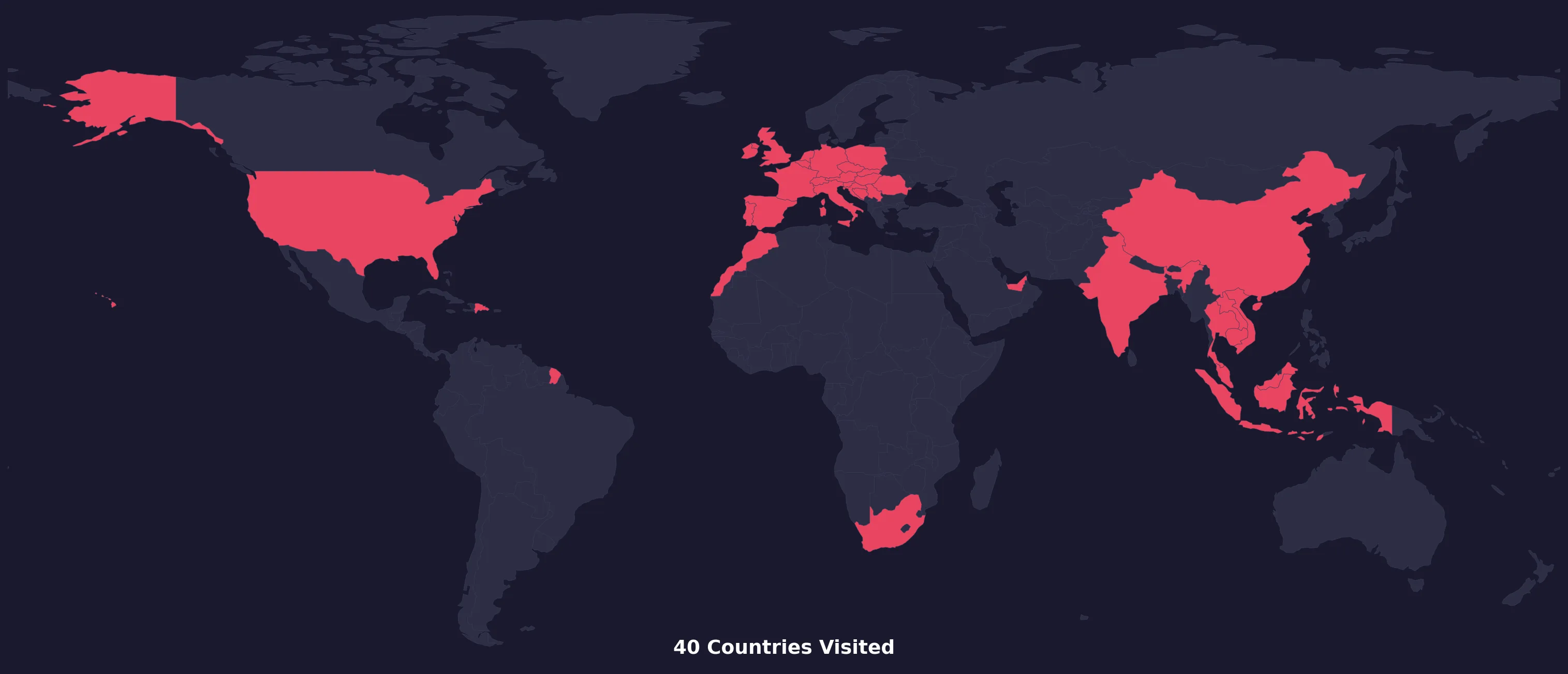
Thirty-nine countries across four continents — mostly by motorcycle, one by bicycle, and one on a Piaggio scooter.
Europe (24 countries)
Andorra, Austria, Belgium, Bosnia and Herzegovina, Croatia, Czechia, France, Germany, Hungary, Ireland, Italy, Liechtenstein, Luxembourg, Monaco, Netherlands, Poland, Portugal, Romania, Serbia, Slovakia, Slovenia, Spain, Switzerland, United Kingdom
Asia (10 countries)
Cambodia, China, Hong Kong, India, Indonesia, Laos, Malaysia, Singapore, Thailand, Vietnam
Africa (2 countries)
Morocco, South Africa
Americas (3 countries)
Barbados, Dominican Republic, United States
The map highlights every country I've spent at least a night in. Most of Europe was covered on motorcycle trips between 2013 and 2019. Asia was a single eight-week trip in 2016, riding from Ho Chi Minh City through Cambodia, Thailand, Laos and down through Malaysia to Singapore, with flights to Bali and Hong Kong. India came in early 2026.
Where Next?
One loop to tick off every unvisited European country that’s reachable by road. Sixteen new countries, at least one night in each, roughly 11,000 km (6,800 mi) on the road and five to six weeks at a comfortable pace.
The Route
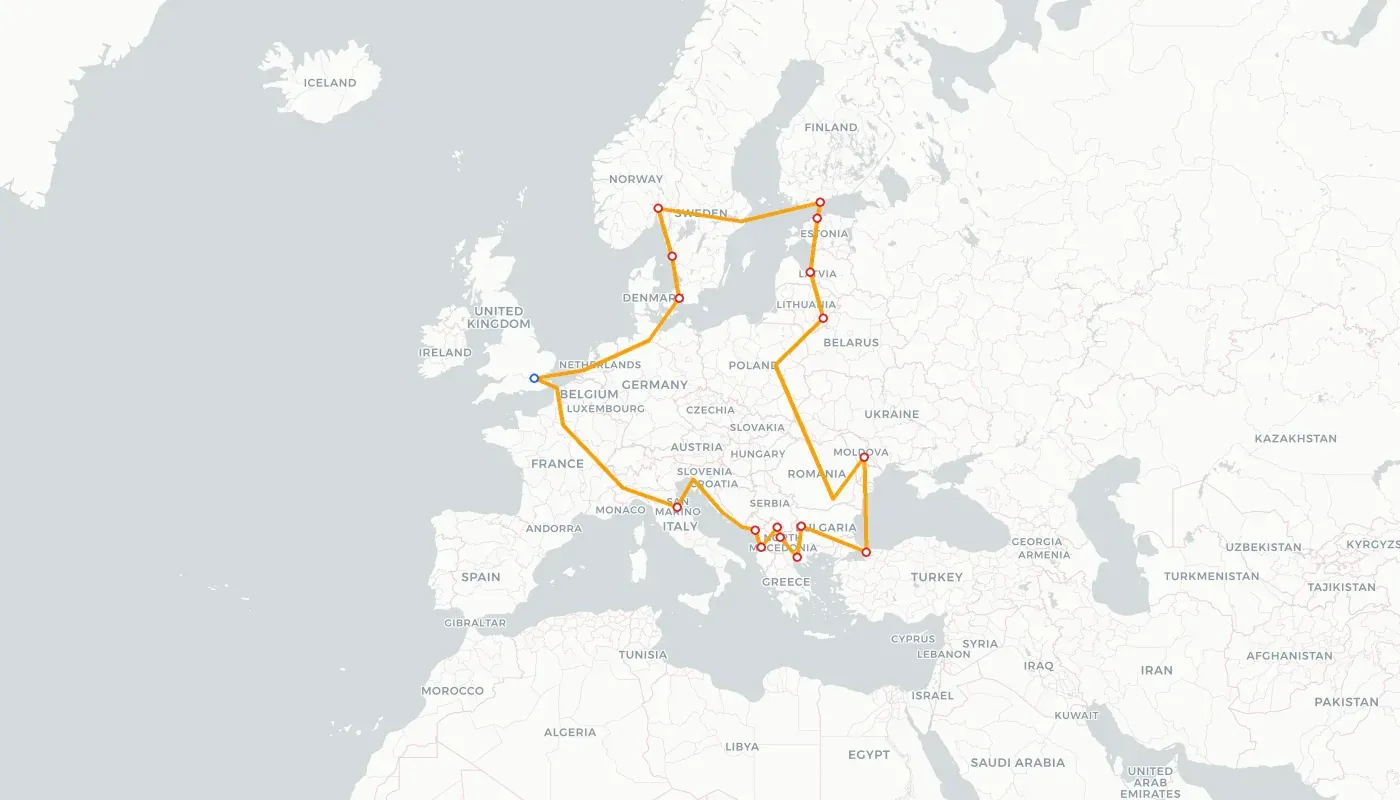
Ferry to the Hook of Holland, then north through Germany to Copenhagen. Cross the Øresund Bridge into Sweden for a night in Gothenburg, then on to Oslo. Back east through Sweden — a second night near Stockholm — then the overnight ferry to Helsinki. A short hop across the Gulf of Finland to Tallinn, then ride south through Riga and Vilnius.
The long transit leg: Vilnius to Bucharest through Poland and Hungary, both already visited. From Bucharest, detour east to Chișinău for a night in Moldova, then south to Istanbul. West to Sofia, down to Thessaloniki, and into the tight Balkans run: Skopje, Pristina, Tirana, Podgorica. Up the Croatian coast to San Marino, then through France to Calais and home.
Overnight Stops
Copenhagen — Denmark. Gothenburg — Sweden. Oslo — Norway. Helsinki — Finland. Tallinn — Estonia. Riga — Latvia. Vilnius — Lithuania. Chișinău — Moldova. Istanbul — Turkey. Sofia — Bulgaria. Thessaloniki — Greece. Skopje — North Macedonia. Pristina — Kosovo. Tirana — Albania. Podgorica — Montenegro. San Marino — San Marino.
Plus two or three transit nights in countries already visited — Stockholm on the way to the Helsinki ferry, Warsaw or Kraków breaking up the long haul to Bucharest, and somewhere in France on the way home.
Visas
UK passport holders need no visa for any country on this route. The Schengen area (Denmark, Sweden, Norway, Finland, Estonia, Latvia, Lithuania, Greece) allows 90 days in any 180-day period — this trip uses around 30 of those. Turkey requires an e-visa, easily bought online before departure.
Bulgaria, Moldova, Kosovo, Albania, Montenegro, North Macedonia and San Marino are all visa-free for UK nationals, each allowing at least 90 days. No border will slow you down beyond a passport stamp.
Wild Camping
Norway, Sweden and Finland have allmansrätten — the legal right to roam and camp anywhere on uncultivated land. These are the best three countries in Europe for wild camping. Estonia and Latvia are similar: wild camping in forests is tolerated and common.
The Balkans are easy. Albania, Kosovo, Montenegro and North Macedonia have no real restrictions on wild camping in rural areas, and locals rarely object. Greece and Turkey are technically restricted but widely tolerated outside towns. Bulgaria is fine in the mountains and countryside.
Moldova has no specific laws against it. Denmark is the exception — wild camping is restricted, but there are hundreds of designated free shelters (shelterplätze) across the country. San Marino is tiny; just book a room for one night.
The Numbers
The full loop: 16 new countries, roughly 11,000 km (6,800 mi), 31 riding days at 350 km (220 mi) a day, plus rest days and sightseeing. Five to six weeks total. Two ferry crossings: Stockholm–Helsinki and Helsinki–Tallinn.
Moldova and Turkey are optional detours adding about 1,700 km (1,100 mi) between them. Without those two, the loop drops to roughly 9,000 km (6,000 mi) and 14 countries — four to five weeks, still the most efficient way to colour in the European map.