 elyob
elyob
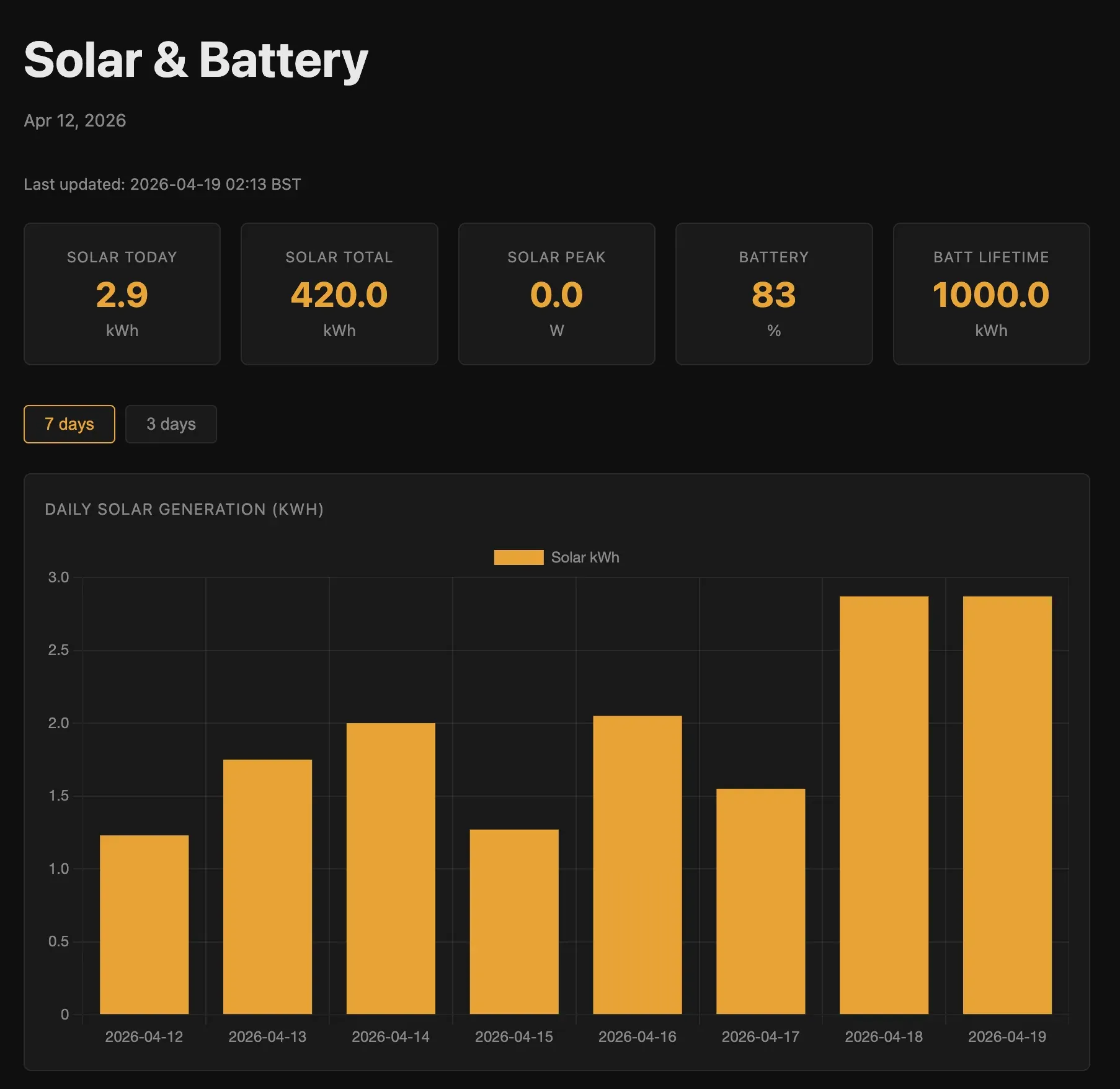
The Fogstar Drift just ticked over 1,000 kWh of lifetime throughput. That's the total energy that's flowed in and out of the battery since it was installed — 511 kWh charged in, 489 kWh discharged back out. Every kilowatt-hour that enters the battery eventually leaves it, so this number is really a measure of how hard the battery has been working.
What surprised me is the solar figure sitting next to it: 420 kWh generated, all from a 600W ground-level array in the garden of a one-bed flat. That 420 kWh of free electricity is worth around £100 at typical grid rates — energy that would have been bought from the grid if the panels weren't there. Some of it charged the battery, some went straight to powering the flat. On top of solar, the battery earns its keep through Octopus Agile plunge charging — filling up overnight when wholesale prices drop to near-zero or go negative, then discharging during the day when rates climb. The average cost across all the energy I use sits at just 18.8p per kWh, well below the standard Agile average.
The "Batt Lifetime" number on the solar dashboard is calculated by adding two Home Assistant sensors together: fogstardrift_total_energy_input (everything charged into the battery) and fogstardrift_total_energy_output (everything discharged). It's a simple sum, but it tells a useful story — how many kilowatt-hours the battery has saved you from buying at peak rate.
The whole setup was a major investment for a small flat. Panels, battery, inverter, wiring — it adds up. But the maths is starting to work. Between solar generation, plunge pricing, and the battery shifting cheap energy into expensive slots, the system is quietly paying for itself. Not overnight, but steadily. The 1,000 kWh milestone is just a number, but it's a satisfying one.