 elyob
elyob
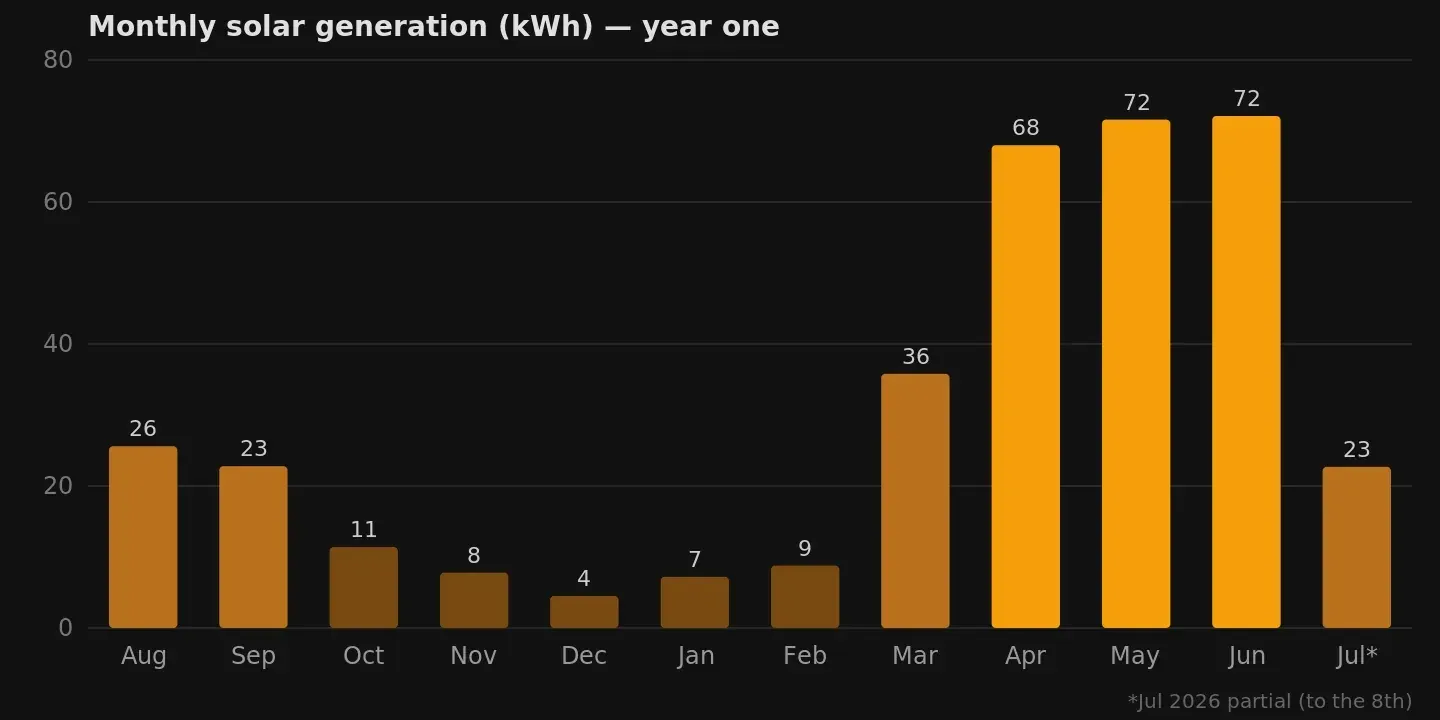
In December my panels made 4.5 kWh. Not in a day — for the whole month. In June they made 72. This is the story of the year my garden woke up.
A year ago, on 15 July 2025, I bolted four second-hand solar panels to salvaged pallet frames at ground level in the garden, wired them to a 6.7 kWh battery on a board indoors, and started logging every watt. What followed was less a straight line than a slow seasonal tide — out through the autumn, almost gone by midwinter, then rushing back in the spring.
The Lean Months
Solar monitoring came online on 10 August, so the first full picture starts there — 26 kWh in what was left of August, then a steady decline as the sun dropped lower. October managed 11 kWh, November 8, and December bottomed out at a feeble 4.5. On the darkest days the array barely stirred; a whole afternoon might yield what a single sunny hour does now.
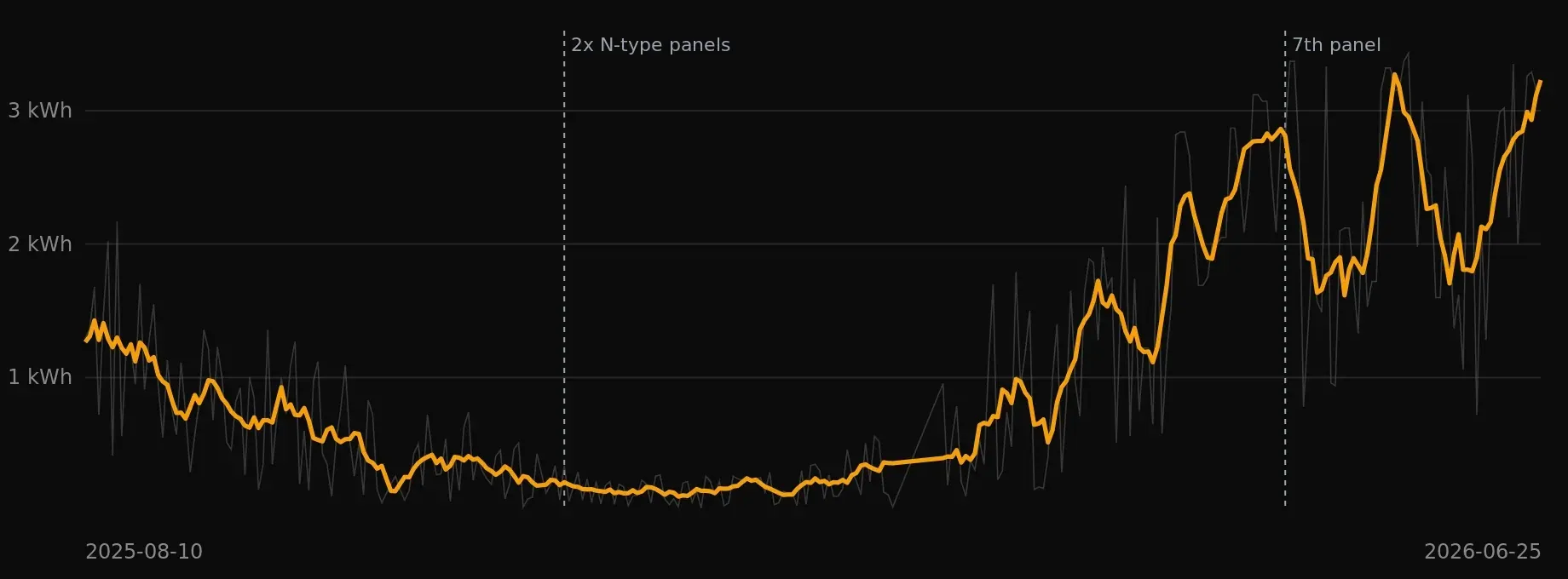
It was in that gloom, on 23 November, that I did something that felt faintly absurd: I added two more panels. Straight into the darkest weeks of the year, when they'd do almost nothing for months. But the array is afternoon-weighted and shade-limited, and the plan was always to be ready for the light when it returned — not to chase what little there was in December.
The Switch-On
March is when it turned. The panels jumped from 9 kWh in a dim February to 36 in March, and then the real switch flipped: 68 kWh in April, 72 in May, 72 again in June. Nearly a tenfold leap in ten weeks. The same frames, the same garden — just a sun that had finally climbed high enough to clear the surrounding shade for most of the day.
I added a seventh panel at the end of April, right as the season peaked, which widened the shoulders of each day rather than the midday cap — exactly what I'd hoped. The best days stopped being about noon and started being about how early the array woke and how late it kept going.
The Peak
And then, ten days before the anniversary, the record fell. On 5 July 2026 the array made 3.45 kWh — its best single day ever — nudging past a mark that had stood since late May. Every one of my top days now sits in the last two months. The garden isn't just awake; it's having its best summer yet.
The daily averages tell the same story in miniature. December limped along at 0.15 kWh a day, January barely better at 0.23. By April that had jumped to 2.27, May 2.31, June holding near 2.25 — and since the array reached full size at the end of April it has run at roughly 2.3 kWh a day, more than double the lifetime average that the winter months drag down.

The Top 20
The leaderboard backs the tide theory outright: every entry in the top twenty now comes from late April onwards. Not one of my best days predates the spring switch-on.
| # | Date | Yield |
|---|---|---|
| 1 | 27 Jul 2026 | 3.54 kWh |
| 2 | 5 Jul 2026 | 3.45 kWh |
| 3 | 12 Jul 2026 | 3.45 kWh |
| 4 | 6 Jul 2026 | 3.44 kWh |
| 5 | 27 May 2026 | 3.43 kWh |
| 6 | 13 Jul 2026 | 3.43 kWh |
| 7 | 3 Jul 2026 | 3.38 kWh |
| 8 | 11 Jul 2026 | 3.38 kWh |
| 9 | 1 May 2026 | 3.37 kWh |
| 10 | 2 May 2026 | 3.37 kWh |
| 11 | 26 May 2026 | 3.37 kWh |
| 12 | 20 Jul 2026 | 3.37 kWh |
| 13 | 19 Jun 2026 | 3.35 kWh |
| 14 | 18 Jul 2026 | 3.35 kWh |
| 15 | 9 May 2026 | 3.33 kWh |
| 16 | 7 Jul 2026 | 3.33 kWh |
| 17 | 29 Jul 2026 | 3.33 kWh |
| 18 | 22 May 2026 | 3.32 kWh |
| 19 | 23 May 2026 | 3.32 kWh |
| 20 | 2 Jul 2026 | 3.30 kWh |
A Year In
Across the whole year the panels generated 358 kWh over 322 logged days. That won't heat a house, and it was never meant to — this is a one-bed garden flat, not a rooftop farm. What the solar can't cover, the battery quietly does: through the dark months it leaned on cheap overnight grid slots and the occasional plunge where the price goes negative and I'm paid to charge, banking about £73 of arbitrage and £8 of getting paid to take power off the grid.
On the ledger, a year of this has paid back roughly a tenth of the £2,200 it cost to build. On a spreadsheet that's a long road. But the spreadsheet was never really the point — the point was to see whether a scavenged array in a shady garden could be made to earn its keep, and to watch, week by week, a small patch of pallets turn sunlight into something useful. A year in, on both counts, the answer is yes.
Next winter the panels will go quiet again, and I know now not to worry when they do. The tide goes out. Then, right on cue, it comes back in.