 elyob
elyob
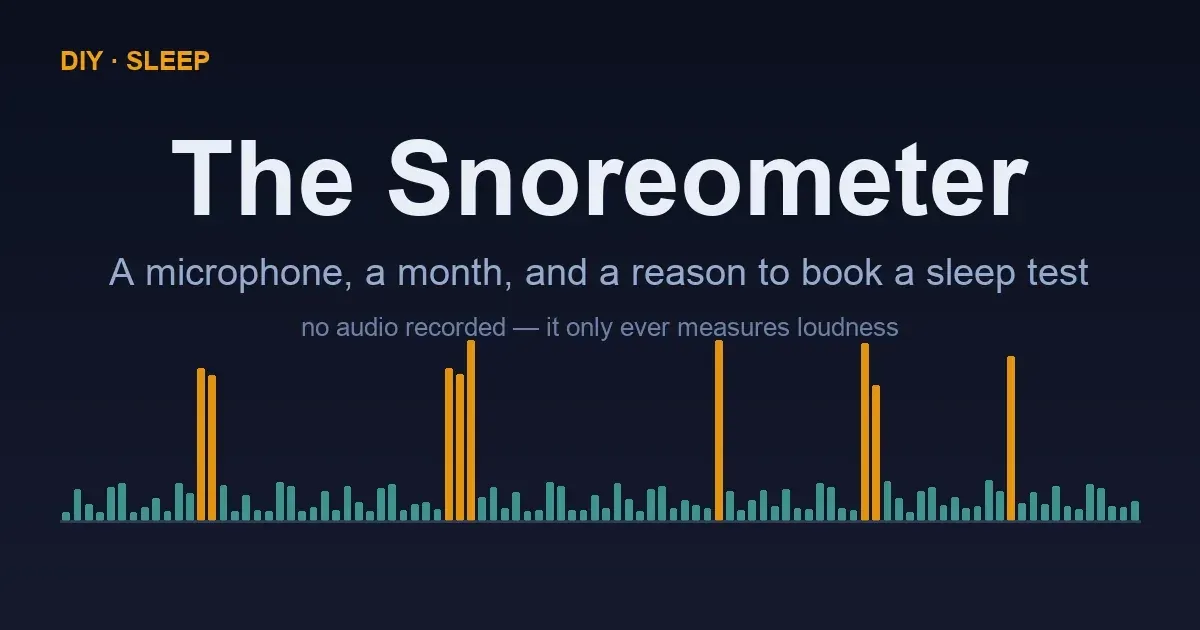
I built a thing that sits on the bedroom shelf and listens to me sleep. It's a microphone and nothing else — no camera, no wristband, no recording. It measures how loud the room is, a few times a second, all night. I called it the Snoreometer, because naming it anything more clinical felt like tempting fate.
Under the hood it's about as simple as hardware gets: a tiny MEMS microphone wired to an ESP32, running ESPHome. It never captures audio — it can't play a single second of the night back — it only logs a sound level in decibels. Anything above a threshold I picked myself, lasting a second or ten, gets counted as a snore.
I built it because I had a suspicion, not a diagnosis. I wake up tired, I'm reliably told I snore like a chainsaw, and sleep apnea sits squarely in the demographic I've wandered into. I wanted something to tell me whether there was anything there — or at least enough of a hint to stop putting off a proper test.
Here's what a week and a bit of listening looked like. The snore counts climb, dip, and on one night go clean off the scale:
| Morning of | Snores | Snore min | "Apnea-band" | Longest gap (s) |
|---|---|---|---|---|
| 29 Aug | — | — | 144 | 88.3 |
| 30 Aug | 0 | 0.0 | 18 | 81.3 |
| 31 Aug | 275 | 10.8 | 73 | 89.8 |
| 1 Sep | 582 | 23.5 | 158 | 89.8 |
| 2 Sep | 418 | 18.5 | 187 | 89.8 |
| 3 Sep | 793 | 42.7 | 200 | 88.3 |
| 4 Sep · worst | 1,056 | 43.4 | 504 | 87.8 |
| 5 Sep | 130 | 6.1 | 29 | 87.8 |
| 6 Sep · last night | ~170 | 10.6 | 31 | 82.8 |
"Apnea-band" = a silence between snores of 12–90 s, not a measured breathing pause. "Longest gap" was capped at 90 s until 5 Sep — readings near 90 mark the edge of the measurement window, not the length of a pause. Blood-oxygen is not from this device (see below).
The night of the 4th (amber) ran clean off the top — over a thousand.
The fourth of September is the one that made me sit up. Over a thousand snores counted, forty-odd minutes of it, and the device's own "apnea-band" counter — more on which in a second — ticking past five hundred. That was also, according to my watch, the worst night's sleep of the lot: least sleep, lowest score.
And now the part every honest version of this post has to include: the Snoreometer cannot detect a breathing pause. It never hears breathing at all — only snoring. What it calls an "apnea-band event" is simply a silence between two snores, twelve to ninety seconds long. Silence has a hundred causes: lying still, rolling over, half-waking. It's a screening nudge, not a measurement.
The "longest gap" figures need the same asterisk. Until a change I made on the fifth, any silence longer than ninety seconds was thrown away rather than recorded — so every reading near ninety in that table isn't a ninety-second pause, it's the device admitting it stopped looking. The edge of the window, not the length of the gap.
So I checked the microphone against a completely separate instrument — a Garmin watch on my wrist, which does measure blood oxygen and heart rate. On the one night both ran, they didn't agree. My heart rate around the mic's flagged events averaged 95.5 bpm; across the whole night it averaged 96.6. No meaningful difference at all.
The watch's scariest number that night was a blood-oxygen low of 72%. That sounds alarming — except Garmin tags each reading with a confidence score, and mine were lowest exactly where the readings themselves were lowest. That's the signature of measurement error, not of a body in trouble. And the night's biggest oxygen dip contained almost no snoring at all.
So did my home-made gadget find sleep apnea? No. It can't. What it did was cheaper and, honestly, more useful: it turned a vague "I really should get that looked at" into a spreadsheet of restless nights I couldn't argue my way out of. A cheap microphone I built nagged me into booking the real test.
That's the whole case for the thing, and it's a genuine one. A proper sleep study measures what my microphone only gestures at — airflow, oxygen, effort, the actual pauses. My device's job was never to diagnose. It was to generate enough of a hint to make the appointment, and it did exactly that.
Suspected, not diagnosed — that's precisely where I stand, and where I'm content for a home gadget to leave me. The Snoreometer might, in the roundabout way these things do, save my life: not by finding the problem, but by refusing to let me keep ignoring the question. The next reading that actually matters won't come from a microphone on the shelf. It'll come from a lab.