 elyob
elyob
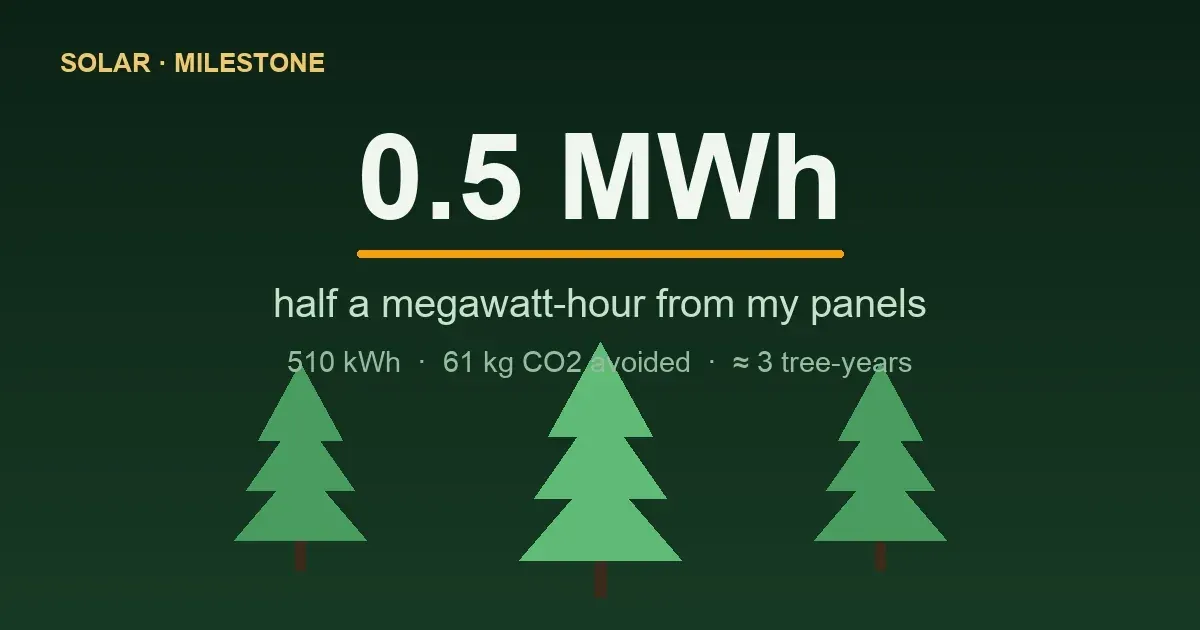
My little solar array just clicked past half a megawatt-hour. Since 10 August 2025 it's put out 510.9 kWh — the meter rolled through 500 kWh and kept going. For seven panels sitting on pallet frames in the garden, half a MWh felt worth marking with something more than a shrug.
So I put a question to the planner to go with the milestone: how many trees is that year of generation actually worth? The short answer is about three — three mature trees, working for a full year. The interesting part isn't the number, though. It's why it's so small.
The raw figure is solid, though I'll be precise about how solid. Two independent measures — the running sum of daily yields and the cumulative meter — agree to within 0.4% across the whole record, not to the last decimal.
That small gap is rather the point: a BLE counter and a meter are genuinely different instruments, and it's exactly that kind of disagreement that catches a bad day when one of them briefly slips. So the half-megawatt-hour I'm celebrating isn't in doubt.
Turning those kilowatt-hours into carbon needs the grid's carbon intensity, and that swings hard through the year. July handed me 89.8 kWh; December just 4.5. Meanwhile the grid ran as clean as 93 gCO2/kWh in April and as dirty as 145 in January. A flat annual average would quietly get the answer wrong.
Weighting each month's generation by that month's real grid intensity — pulled from the National Grid carbon-intensity API — gives a generation-weighted figure of 120 gCO2/kWh, and 61.1 kg of CO2 avoided across the whole 381 days.
| Month | Yield (kWh) | Grid (gCO2/kWh) |
|---|---|---|
| Aug 2025 | 25.6 | 123 |
| Sep 2025 | 22.8 | 113 |
| Oct 2025 | 11.4 | 139 |
| Nov 2025 | 7.8 | 126 |
| Dec 2025 | 4.5 | 120 |
| Jan 2026 | 7.2 | 145 |
| Feb 2026 | 8.8 | 136 |
| Mar 2026 | 35.8 | 117 |
| Apr 2026 | 68.0 | 93 |
| May 2026 | 71.6 | 122 |
| Jun 2026 | 72.1 | 133 |
| Jul 2026 | 89.8 | 122 |
| Aug 2026 | 77.1 | 124 |
| Sep 2026* | 8.5 | 91 |
* September 2026 is a partial month. Grid intensity from the National Grid carbon-intensity API; yield from my own generation meter.
So how many trees is 61.1 kg? There's no single honest answer, and that's rather the point. It depends entirely on which tree, and over what timespan:
at ~22 kg/tree/yr — a mature broadleaf, the figure everyone quotes
at ~2.7 kg/tree/yr — a woodland average taken over 100 years
at ~1 tonne of whole-life sequestration for a single tree
Anyone who quotes a single confident "X trees" number has quietly picked one of those assumptions and not mentioned it. The honest version is a range, and the range spans two orders of magnitude.
But the number being small isn't the panels underperforming — it's the opposite. It's the British grid getting clean. At 120 gCO2/kWh, the electricity I'd otherwise be importing is roughly a quarter as carbon-intensive as it was around 2013, when it sat near 500 g/kWh.
Run the same 510.9 kWh against that older, dirtier grid and it would have avoided about 255 kg — four times as much carbon for the identical panels. Solar's carbon case in Britain has been eroded by the grid decarbonising underneath it. That's a good problem to have.
Two honest caveats sit on top of this. First, 61.1 kg is an upper bound: it assumes every one of those 510.9 kWh displaced a grid import. Anything generated but not used or stored displaced nothing at all.
Second, average intensity is the conservative basis. The plant actually pushed off the margin when I stop importing is more likely gas at around 400 g/kWh — and on that reasoning the figure climbs nearer 200 kg, or roughly nine mature tree-years.
There's a bigger caveat still, and it cuts the other way: none of the kit was carbon-free to make. The panels alone — a 0.7 kWp crystalline-silicon array — carry an embodied-carbon debt that published life-cycle figures put somewhere between roughly 500 and 1,300 kg of CO2, the range that wide because it leans heavily on where they were built.
And the panels are only part of the bill. The 6.7 kWh lithium battery is the other big line — at ~50–100 kg of CO2 per kWh of LFP cells, that's another 350–700 kg, enough to rival the panels on a system this small. The inverter, MPPT and cabling add a bit more; the mounting doesn't, being repurposed pallets whose debt was spent long ago. Shipping it all here, mostly by sea, adds a last and smaller slice.
Add those lines up — very roughly 1,000 to 2,300 kg of CO2 for the whole system — and set them against 61.1 kg avoided a year, and the arithmetic turns sobering. Carbon payback lands somewhere around sixteen to thirty-eight years: quite possibly longer than the kit will physically last.
That's the uncomfortable mirror of the clean-grid story. The greener the grid gets, the less carbon each home-generated kilowatt-hour saves — so the harder a small setup like mine has to work to justify its own manufacture and shipping. Built for the grid of 2013 it would have repaid that debt years ago; built for the grid of today, it may not fully repay it at all.
And the trees on the other side of the comparison aren't a sure thing either. "Three tree-years" assumes three trees that actually live. Planted saplings don't all make it — real schemes lose a meaningful share early and more later — so banking that carbon in living wood would mean planting more than three, and waiting decades to learn how many took. A tree is a probabilistic promise; a kilowatt-hour already generated is not.
And the money? I'm deliberately not putting a precise figure on it here — but the financial case for this kit is far stronger than the carbon one. The pounds saved have always been the better story than the kilograms of CO2.
Half a megawatt-hour down, then. Three tree-years of carbon on the generous reading — far thinner once the kit's own manufacture and shipping, and the odds on a sapling, are netted off, and on the gloomy end perhaps none at all. The money case stays clear, though: this kit repays in pounds far faster than in kilograms. The milestone stands; the honest accounting just won't make it heroic.